Finding the Art in Artisanal Blacksmithing
As I mentioned in a previous post relating to my belt buckle work, forging metal opens up so many possibilities in terms of form and texture. While I have dabbled a bit in the more artisanal aspects of blacksmithing, I am excited to be diving more seriously into formal artwork.
As I mentioned in a previous post relating to my belt buckle work, forging metal opens up so many possibilities in terms of form and texture. While I have dabbled a bit in the more artisanal aspects of blacksmithing, I am excited to be diving more seriously into formal artwork.
A recent trip to Santa Fe, NM and discussions with other, more established artists lit the fire under me and I made some important realizations:
I fee like I’m finally able to leverage a broader skillset obtained through the last 10 years of blacksmithing,
I’m somehow more open and inspired and seem to be experiencing a near constant flood of ideas to work on (!?)
A newfound understanding of how to approach galleries, museums and other art outlets doesn’t hurt (essentially, I have plan and the prospect doesn’t feel as daunting as it did)!
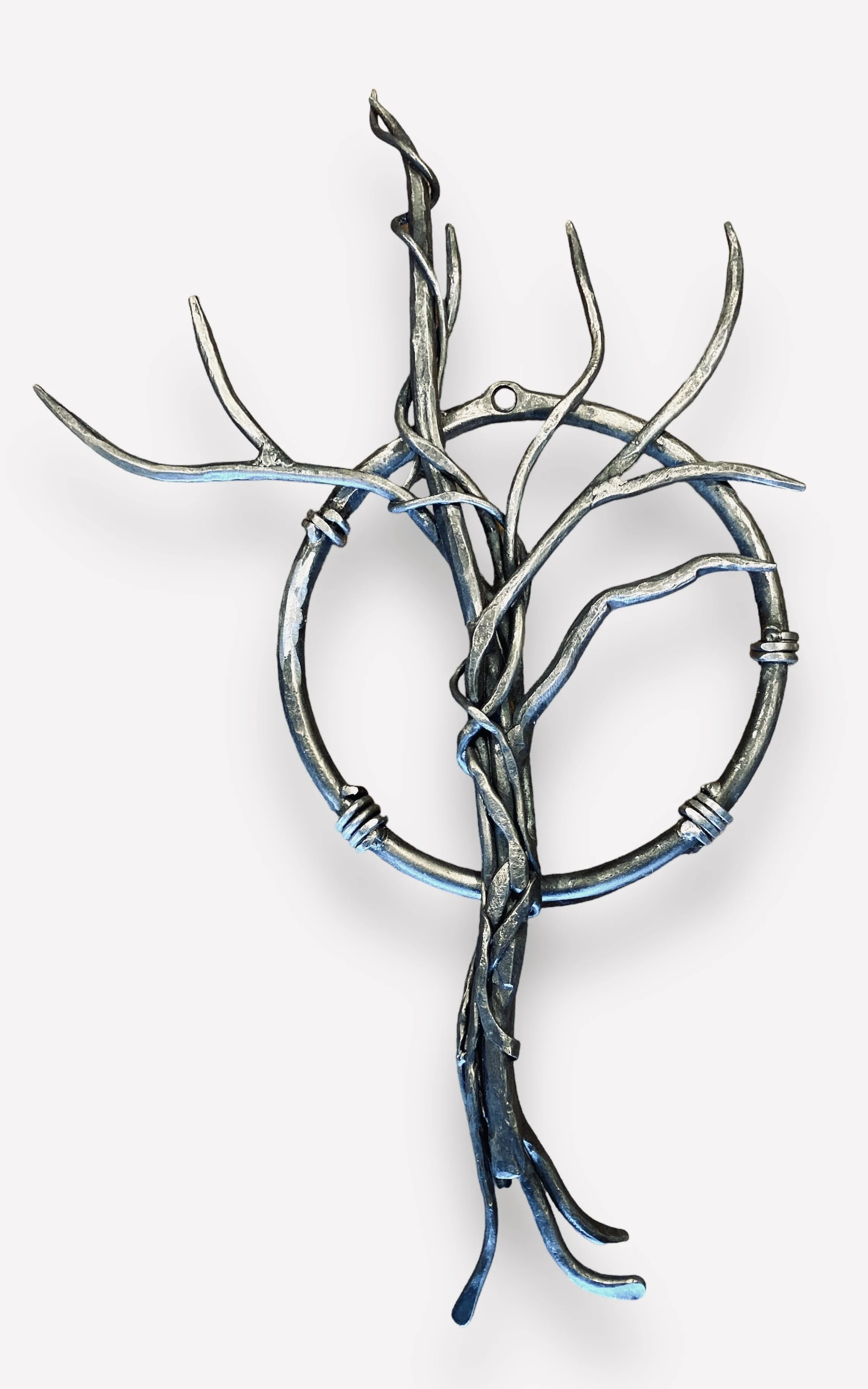
In recent years, I have been lucky to have consigned some of my pieces with remarkable businesses such as 4Ravens Gallery in Missoula, Ninepipes Museum in Charlo and the Paws Up People and Culture Center in Missoula. However, more recently, a piece “Ammonite Study” was accepted into Helena’s Holter Museum 2024 Art Auction. I’m very excited about this!

Ammonite Study

Detail
Lastly, I have been developing a separate artwork page (work in progress) that can be found HERE, and plan to continue to support Montana arts by submitting pieces to fundraiser events throughout Montana over the next year. Simultaneously, I will be slowly building a body of work; some themes I look forward to exploring separately and/or jointly include:
Geology, Earth Process and Landscape
Bowls and Vessels
Hand Tool Appreciation
Fossil forms
Early Industrial Forms
Wildlife and Origami
Jewish Heritage
Thanks for visiting and stay tuned!

Refuge
It might feel easy to idealize life on a farm. Space. Animals. Days under the warm sun, surrounded by and cultivating beauty. Being your own boss. Owning your time. Zach and I certainly have idealized this kind of life. How do you think our butts ended up here? Idealism has its place—right? Couldn’t a person consider it one aspect of the dreaming? Isn’t is a part of the formula that drives us to something different . . . better than the reality we currently inhabit? And don’t we all want that—something better? It is part of the human nature, I believe. Therefore, I don’t chide myself too hard when life is less than idyllic. Just because we went for the dream, doesn’t mean we were under any illusion that it would be smooth sailing. Or sailing at all. But what is the point of ignoring the thing that pulls on you so hard, you can’t help but follow the yarn to the knot?
. . . even if it is just to see it unravel, in ways you never would have imagined. And then realizing that “better” is in your hands.
It might feel easy to idealize life on a farm. Space. Animals. Days under the warm sun, surrounded by and cultivating beauty. Being your own boss. Owning your time. Zach and I certainly have idealized this kind of life. How do you think our butts ended up here? Idealism has its place—right? Couldn’t a person consider it one aspect of the dreaming? Isn’t it a part of the formula that drives us to something different . . . better than the reality we currently inhabit? And don’t we all want that—something better? It is part of the human nature, I believe. Therefore, I don’t chide myself too hard when life is less than idyllic. Just because we went for the dream, doesn’t mean we were under any illusion that it would be smooth sailing. Or sailing at all. But what is the point of ignoring the thing that pulls on you so hard, you can’t help but follow the yarn to the knot?
. . . even if it is just to see it unravel, in ways you never would have imagined. And then realizing that “better” is in your hands.
Over the last (almost) 6 years, I have found myself tugging at different threads in the yarn. We had clear reasons for choosing this path, and then there were all the other reasons that maybe weren’t so clear. The reasons that simmer and brew in the subconscious, the unconscious, the spirit, the body . . . wherever they choose to arise and dwell.
One thing that was clear to me from the moment we set foot on this place, was that it wasn’t ours, but ours to be in relationship with. That is wasn’t ours, but I knew it already, just the same. That is wasn’t ours and therefore, it was meant to be shared in some way. The more shrewd reader might ask: well if it isn’t yours, then it isn’t yours to share. Aha! Therein lies the paradox endemic in so many aspects of this life I am experiencing. Zach and I often lament the limitations our society places on the heart. And maybe that is a topic for another time, but the bottom line is that we recognize the privilege we have in “owning” this land and having the home that we have and trying to dig, grow and hammer out a living in the way that we choose. And, it isn’t all kittens and peonies, though you wouldn’t know it from our instagram page. But that is besides the point, because really, neither of us want to make our way in the world without helping others along. And each time I work at this yarn, teasing apart the threads, the one that stays strong, never frays, and always catches my eye, is refuge. (Which, by the way is the title of one of the most influential books in my own evolution—by Terry Tempest Williams. Happy Women’s History Month to another great one!)
Refuge. When you live on a farm, one thing that becomes abundantly clear is that everything is a refuge for someone. You stack wood, you get a whole metropolis of insects. You make a pile of brush, you get a boisterous park for sparrows. You leave anything on the ground for more than a day and the voles have moved in. Compost pile, skunks. Old trailers, fox naps. Uncovered pipe, wasp nest. Log deck, pregnant feral cat. Your heart, all the pain and joy of living, wrapped up in a daily truth bomb. Sure, that last one sounds a touch dramatic, but it’s sort of hard to sum up what has taken refuge in my heart, since moving here, and how I have taken refuge in the farm. It’s reciprocal. At least, that is what I am trying to weave in.
Those closest to me are aware that I experienced decades of debilitating, chronic health issues, that finally came to a head, and a conclusion, here, on the farm, just over a year ago. The best summary of that, if you want to know more, can be found at this link: No more migraines (and other crap). I am not inclined to dwell on that, except to say that I hope my story can provide hope to others and also, it played a part in how our business/life has evolved. Regardless, the thing I want to say is that this place and the time here has been healing to me in profound ways, and I certainly wouldn’t feel as well as I do now, if it weren’t for the farm. All along, I have wanted it to provide the same kind of refuge to other people. And, we have a handful of friends and family who have taken us up on invitations and come to find a sense of refuge in their visits here. Community is important to us, even though we moved out in the middle of a valley, where community wears all different kinds of clothes and squeezes itself in the crevices between haying, and farming and hunkering down for winter. Sometimes it feels like it doesn’t exist. But then, I just look at the refuge in my heart.
What I really want to say is that life is death and everything in between and refuge is everywhere, you just need to decide what that is for yourself and go seek it. And know that it is here, for you.
To that end, we will keep trying to invent times and spaces that allow you to explore what refuge is for you and to find it. If that looks like self-care (I would say it does), you might be interested in the initial offerings I’ve put together after receiving my reiki master (or level III) certification. Meridian Reiki Montana. If it doesn’t look like that, you might find it watching chickens peck endlessly at the tender green shoots of grass poking up all around you. Or by listening to your dog snore. I hope you find it. And if you do, please tell me where it is for you.

There’s Treasure Everywhere
Recently, while wondering in the Missions, I found a cup! It was of the insulated, stainless steel type; perfect for hot drinks on cold days in the blacksmith shop. Having just been perusing Calvin and Hobbes, I thought to myself… “there’s treasure everywhere!”
Recently, while wondering in the Missions, I found a cup! It was of the insulated, stainless steel type; perfect for hot drinks on cold days in the blacksmith shop. Having just been perusing Calvin and Hobbes, I thought to myself… “there’s treasure everywhere!”

Hello new cup!
This perspective can be brought into just about any aspect of life of course, but it got me thinking that especially in my blacksmith work - there really is treasure everywhere in the form of scrap metal that can be repurposed for a variety of specific tools or tasks.
Steel is wrought as a large variety of alloys, its content optimized for some specific use or small range of uses. When a specific tool or part, be it a car spring, drill bit or tiller blade, reaches the end of its life span, it can easily be reborn as something else via the forge. Here are some examples:

While wondering some train tracks a few years ago, I found this ~ 1.5” round bar stock (foreground). That it sheared so raggedly (on the left hand side), indicated it was some higher carbon steel. Cutting off a chunk, punching a hole and offsetting the face produced a handy ‘set hammer’ (handled tool, top). A nice tool for establishing tenons over the edge of the anvil.
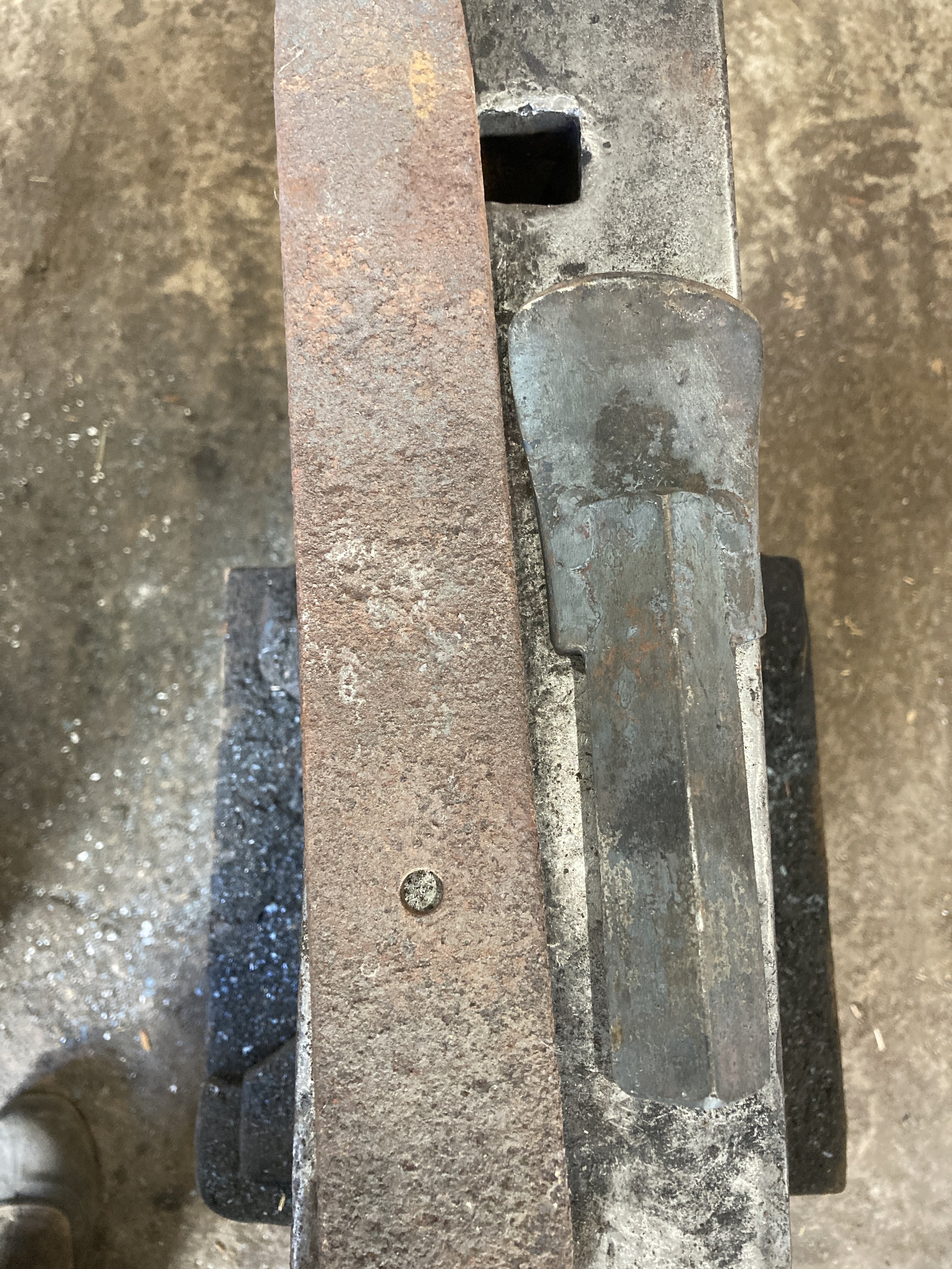
On the left is a leaf spring a buddy found (also in the Missions, a range of infinite resource!). There are many applications for leaf springs as they are a great source of high carbon steel in handy stock dimensions. Here, a small piece was forged and welded to some angle iron to fit the hardy hole (square hole on the anvil) to be used as a hot cutter.
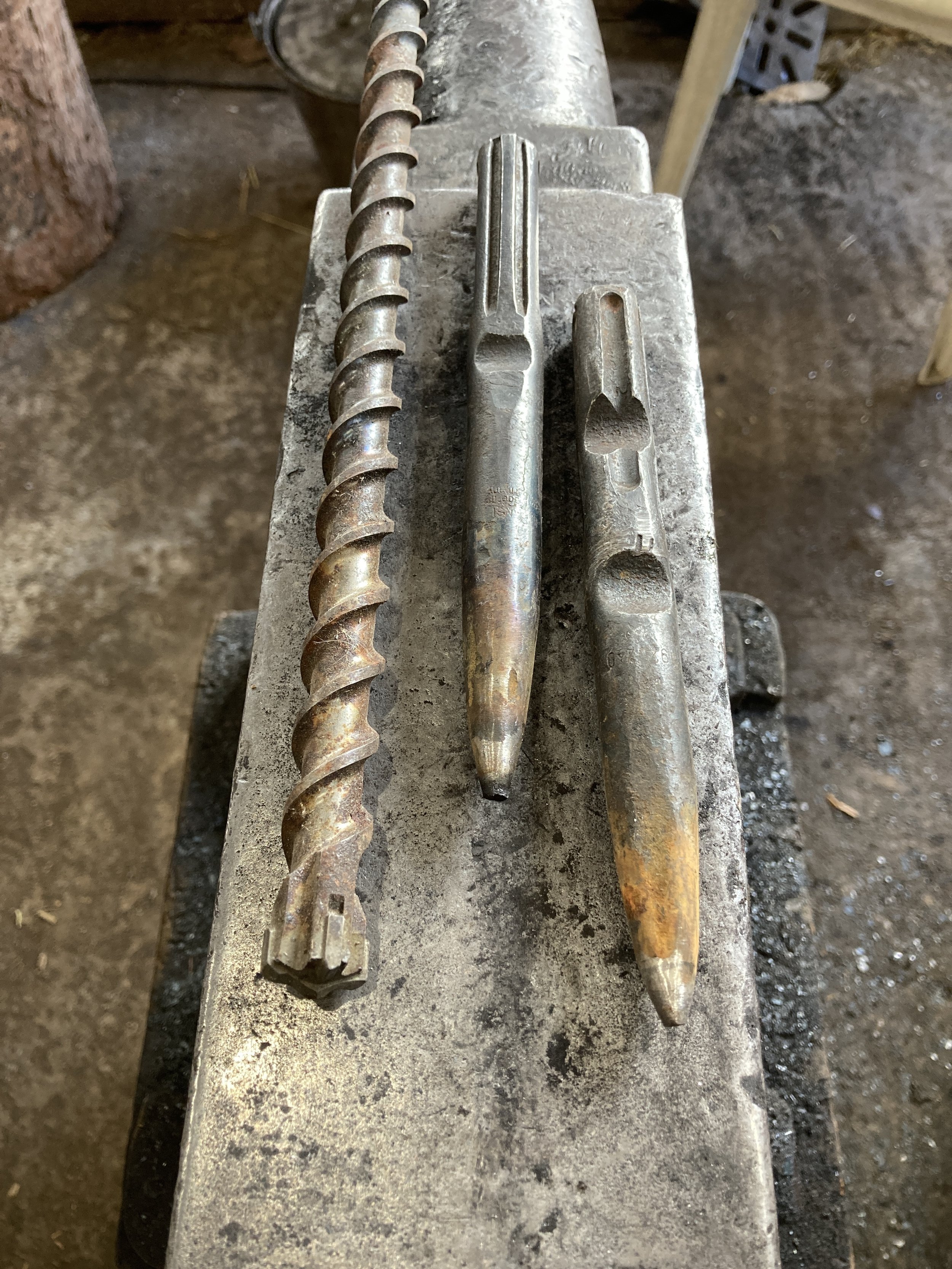
Abandoned hammer bits like this one (on the left) make great stock for general blacksmithing tools such as punches and chisels. Both hot punches were forged from the upper shaft of this drill bit. I use these every day! Thanks old drill bit!

A few years ago, when my neighbor was delivering a round bale of hay, he accidentally broke the hay spike off into the bale, leaving behind a nice bar of high carbon steel.

Here, the tip of the spike has been cut off and welded to some forged stock I found in my scrap pile (an abandoned project of some sort I can’t recall). The tool (right) will serve to spread out holes in heavy stock for taper candles.

I rarely throw steel away (well it gets recycled at the scrap mill if I really can’t use it). I typically try to hold onto all scraps and drops.

Desperate for some scrolling tongs at one point, I forged this pair strictly from bits found in the scrap buckets.
While it may be obvious, it’s important to note that steel is a durable good, and nearly, infinitely reusable. In any case, these are just a few examples amongst many of recycling potential in metalwork.
Lastly, while blacksmithing is inherently gratifying work, the practice of reusing old materials through resourcefulness, adaptability and creativity is one of my favorite aspects of it.
Power to the Pollinators
Full Disclosure: I am kind of a geek. A pollinator geek. It started innocently enough. As a little girl, running wild in rural Vermont, I was drawn to the fields of daisies, black-eyed Susans, stinking bob and queen Anne’s lace. Consequently, I became acquainted with the bees and butterflies that frequented the same fields. Color, shape, movement—it was all very magical to me. I remember running at top speed, through the head-high grasses and flowers one day, mouth agape (either in joy or breathlessness, who knows) and suddenly feeling the furry, bulky buzz of a bumble bee between my bottom lip and teeth.
Full Disclosure: I am kind of a geek. A pollinator geek. It started innocently enough. As a little girl, running wild in rural Vermont, I was drawn to the fields of daisies, black-eyed Susans, stinking bob and queen Anne’s lace. Consequently, I became acquainted with the bees and butterflies that frequented the same fields. Color, shape, movement—it was all very magical to me. I remember running at top speed, through the head-high grasses and flowers one day, mouth agape (either in joy or breathlessness, who knows) and suddenly feeling the furry, bulky buzz of a bumble bee between my bottom lip and teeth. We both came out of that incident unscathed, and I remembered to close my mouth after that. But I didn’t like the bees any less. In fact, my curiosity only grew from there. Perhaps it was on that day that they became more of me, and I, more of them.
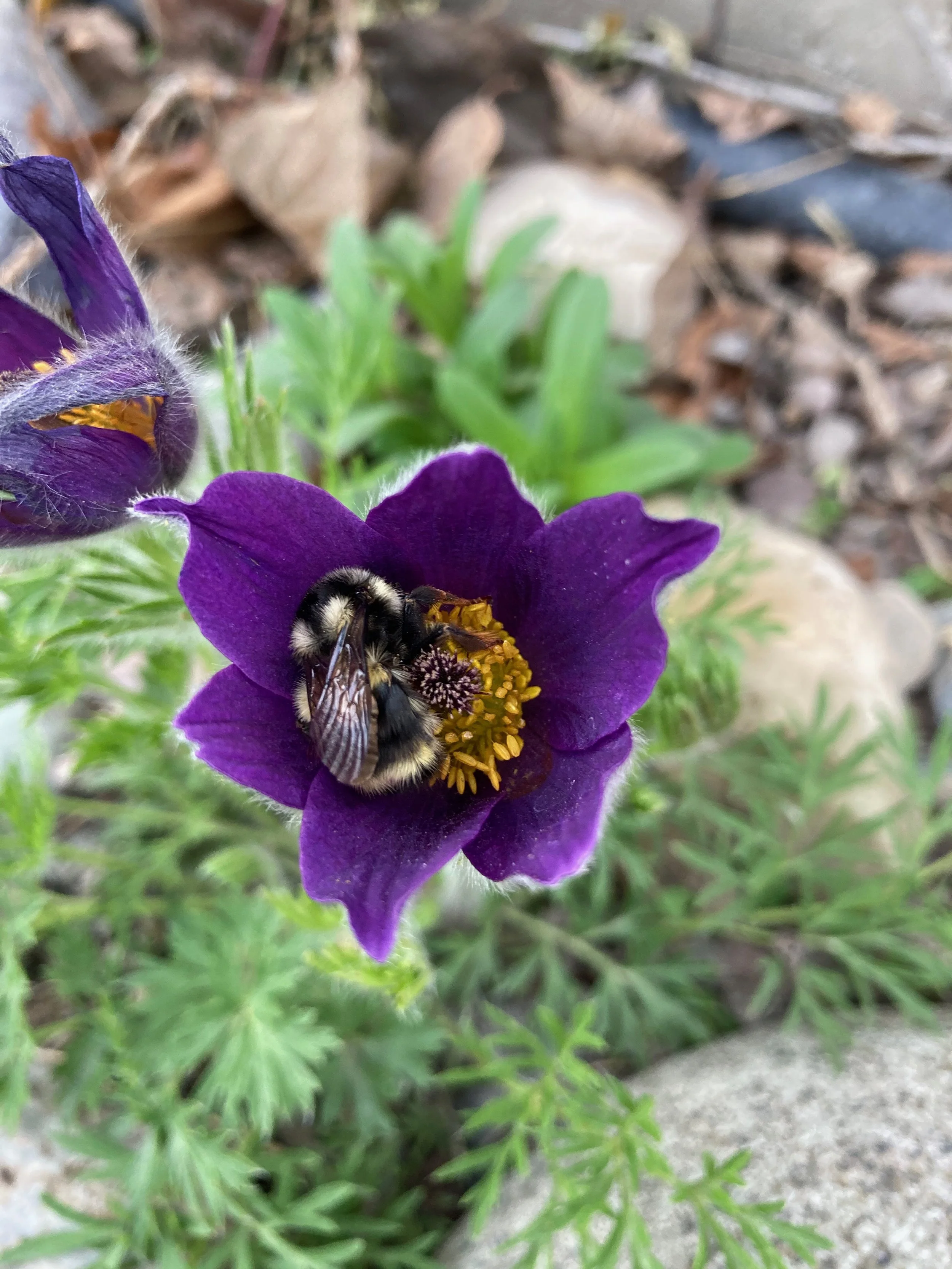
I love farming flowers because I am obsessed with beauty and making people smile, and showing people that they are loved. But I don’t farm flowers just for the flowers or the people, alone. It’s for the relationship with the natural world, the interconnectedness and the partnership—a partnership with countless living creatures that inhabit this land—and pollinators are integral to that. We chose flowers, in part, because we wanted to support our ecosystem and our partners in this ecosystem—and by doing so, we support our food systems, and access to daily connection and joy. Meridian isn’t simply a farm, it is a sanctuary—and by supporting pollinators, we are fostering refuge for anyone who comes in contact with us.
Over the last five years, we have steadily increased pollinator habitat on the farm, with the aim of truly creating a pollinator sanctuary. How?
Each season, we identify a new area at the farm where we want to plant native and pollinator friendly plants, exclusively for the pollinators. That means that we don’t harvest in these areas, and that we usually set up a place for people to observe the pollinators without disturbing them.
We continue to plant trees that provide food and habitat for pollinators.
We harvest flowers at a time of day when pollinators are less active, and examine every bloom to make sure it doesn’t go into the cooler with any hitchhikers.
In our growing fields, we plant more and more pollinator positive varieties each year, including perennial crops that provide habitat year-round.
We often don’t cut back certain varieties of plants in the fall, so they can continue to provide food and shelter in the colder seasons.
We minimize attractants to areas where nesting insects might be in conflict with human activities.
We minimize use of chemicals and utilize organic practices to avoid putting pollinators in peril.
We continuously pursue and support conservation funding and education to help support these efforts.
We look for opportunities to provide education about pollinators on the farm, so stay tuned!
Want to support our efforts? Check out Peonies for Pollinators.
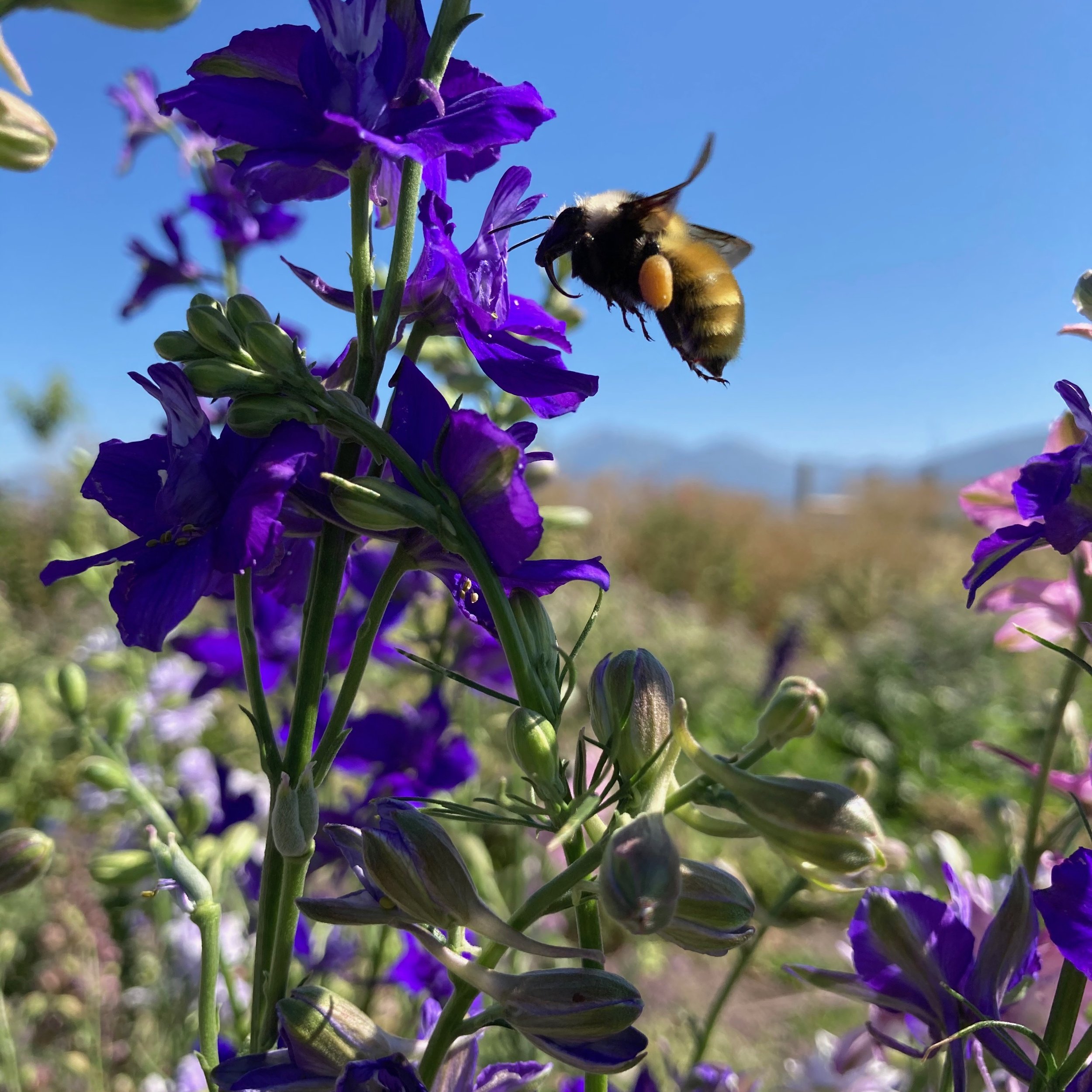
Peonies for Pollinators
This is our CSA program that we do in partnership with Montana Natural History Center. A portion of our sales goes to MNHC to support their programs, and of course, we also use some of the proceeds to expand our pollinator sanctuary.

Belt Buckle : Tool for Innovation and It Holds Up Your Pants!
Tool making is an integral part of blacksmithing. There are so many tools to make in the blacksmith shop: tongs, hammers, punches, chisels, drifts, hardy tools, jigs, fullers, swages, etc. On the farm, there are rakes, pitchforks, shovels, scythes and sickles. In the kitchen, there are knives, spoons, bottle openers and on and on. There is an endless fleet of steel tools to be forged!
When I began working with metal, I didn’t think I’d be making belt buckles. But isn’t a belt buckle just another tool?
Tool making is an integral part of blacksmithing. There are so many tools to make in the blacksmith shop: tongs, hammers, punches, chisels, drifts, hardy tools, jigs, fullers, swages, etc. On the farm, there are rakes, pitchforks, shovels, scythes and sickles. In the kitchen, there are knives, spoons, bottle openers and on and on. There is an endless fleet of steel tools to be forged!
When I began working with metal, I didn’t think I’d be making belt buckles. But isn’t a belt buckle just another tool?
Other than holding up one’s pants, I’ve found that making belt buckles is a great way to experiment with the various textures, colors and forms available when working with metal.
There are myriad textures to be achieved in metals via blacksmthing. From punching out shapes with square or circular punches, varying one’s hammer strikes or types of hammers, or even applying weld marks will yield interesting results.
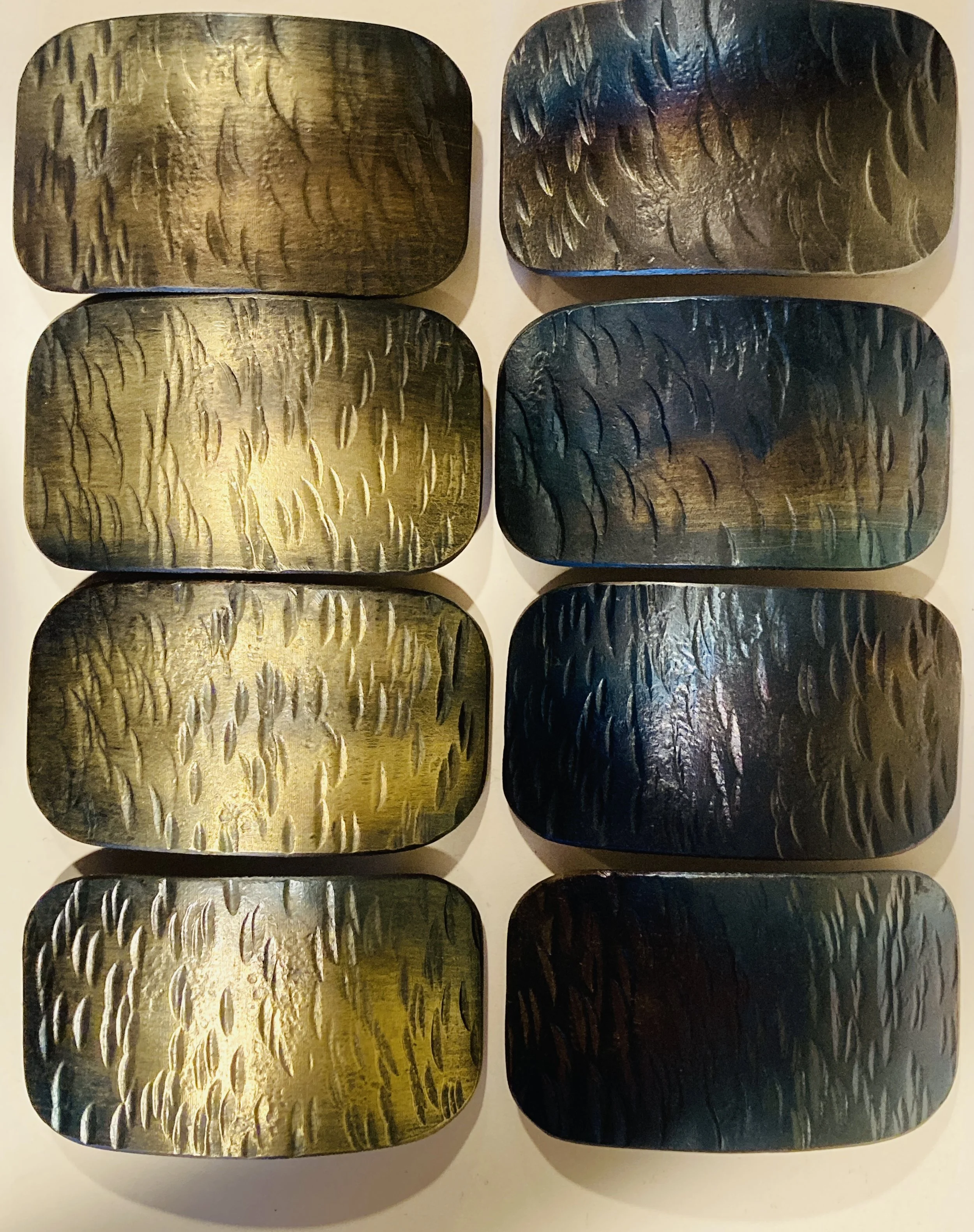
‘Waves’ hand-forged belt buckle. Texture achieved through use of a hand-sledge with a sharp round edge swung repeatedly at an angle.
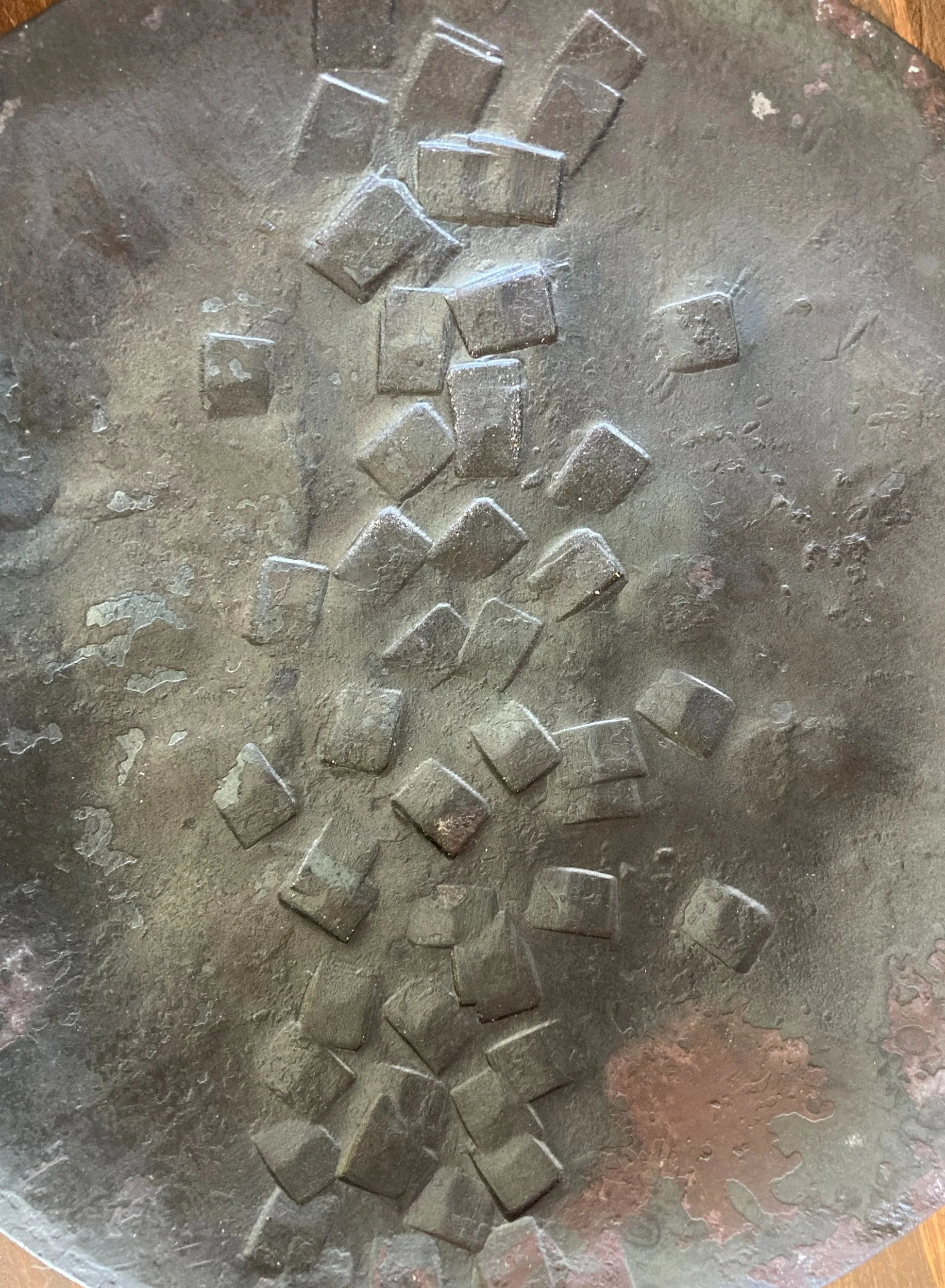
Square punch marks tested on a a small hand-forged dish. I made a standard, handled square punch which was used to assess a pattern of square marks. Looking forward to applying this technique to belt buckles (and light-switch plates) later this winter.
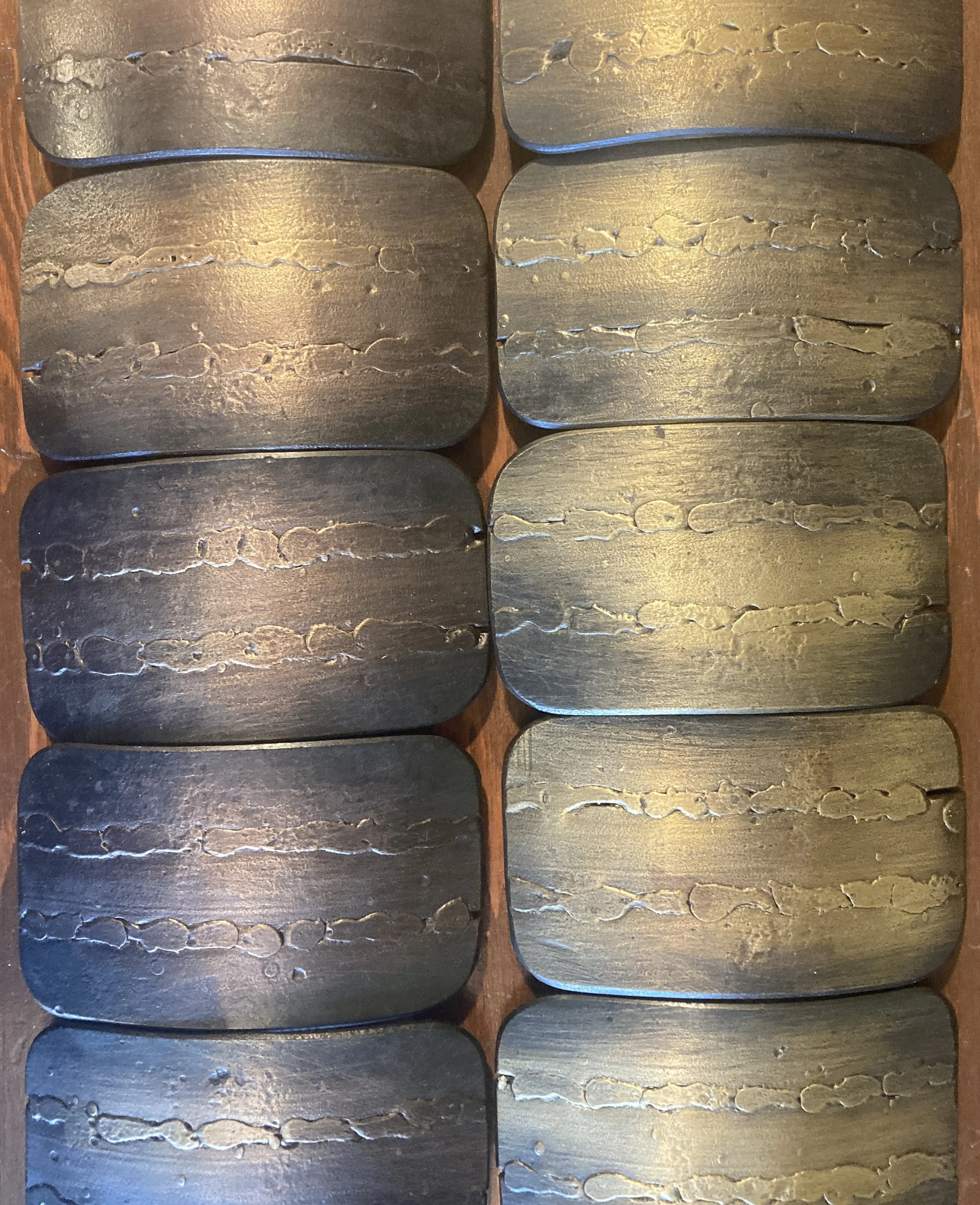
‘Welded Panels’ hand forged belt buckle. This is one of my favorites. Here, strips of steel are fused via sloppy weld beads. I then forge them flat to get this unique texture.
In my limited pursuits, I’ve managed a lot of color variation. Applying a heat gradient through polished steel (and other metals) yields oxidation color gradients - which in steel can be very striking and interesting. Depending on temperature, these gradients can be captured in the final piece in unlimited ways. In addition, various tones can be wrought through brass plating at different temperatures. Mixing these techniques results in a lot of different coloring combinations.
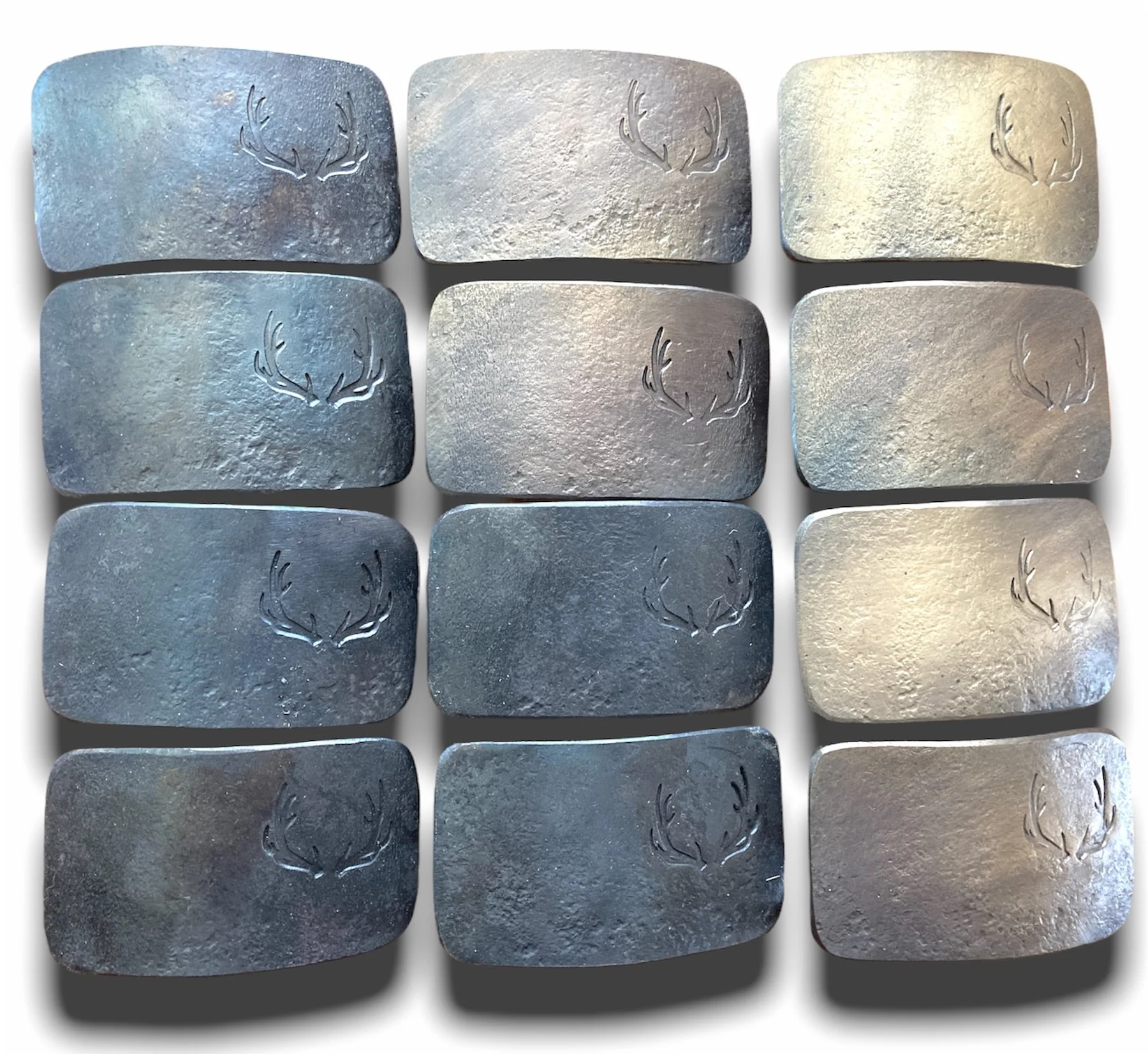
“Elkhorn” hand-forged belt buckle. The color gradient shown here is achieved by uniform heating of the buckle to a specific temperature before ‘arresting’ it with a quench.
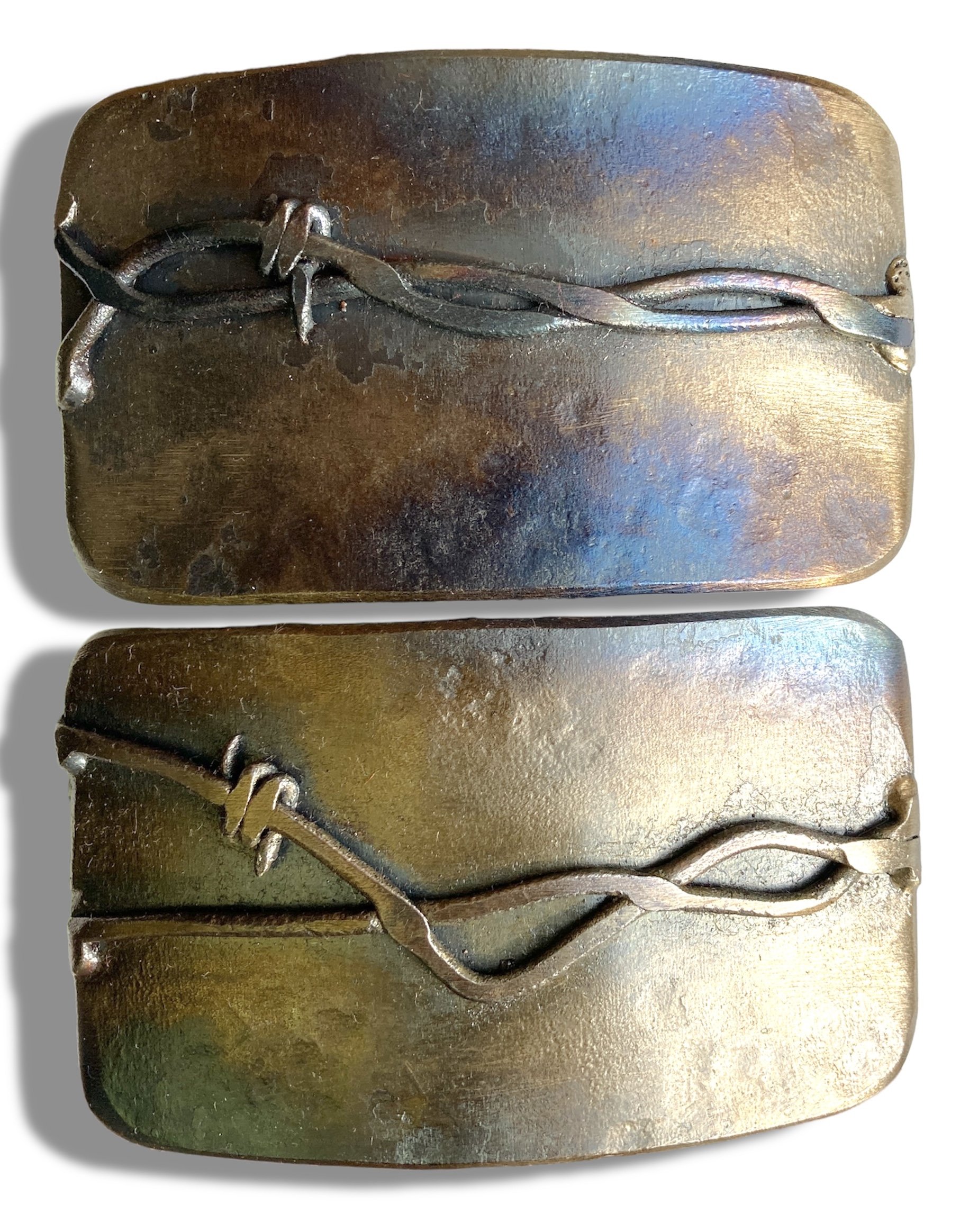
‘Barbed Wire’ belt buckle. Super fun to make. The coloring here is made by ‘running the colors’ across the buckle via asymmetric heating.
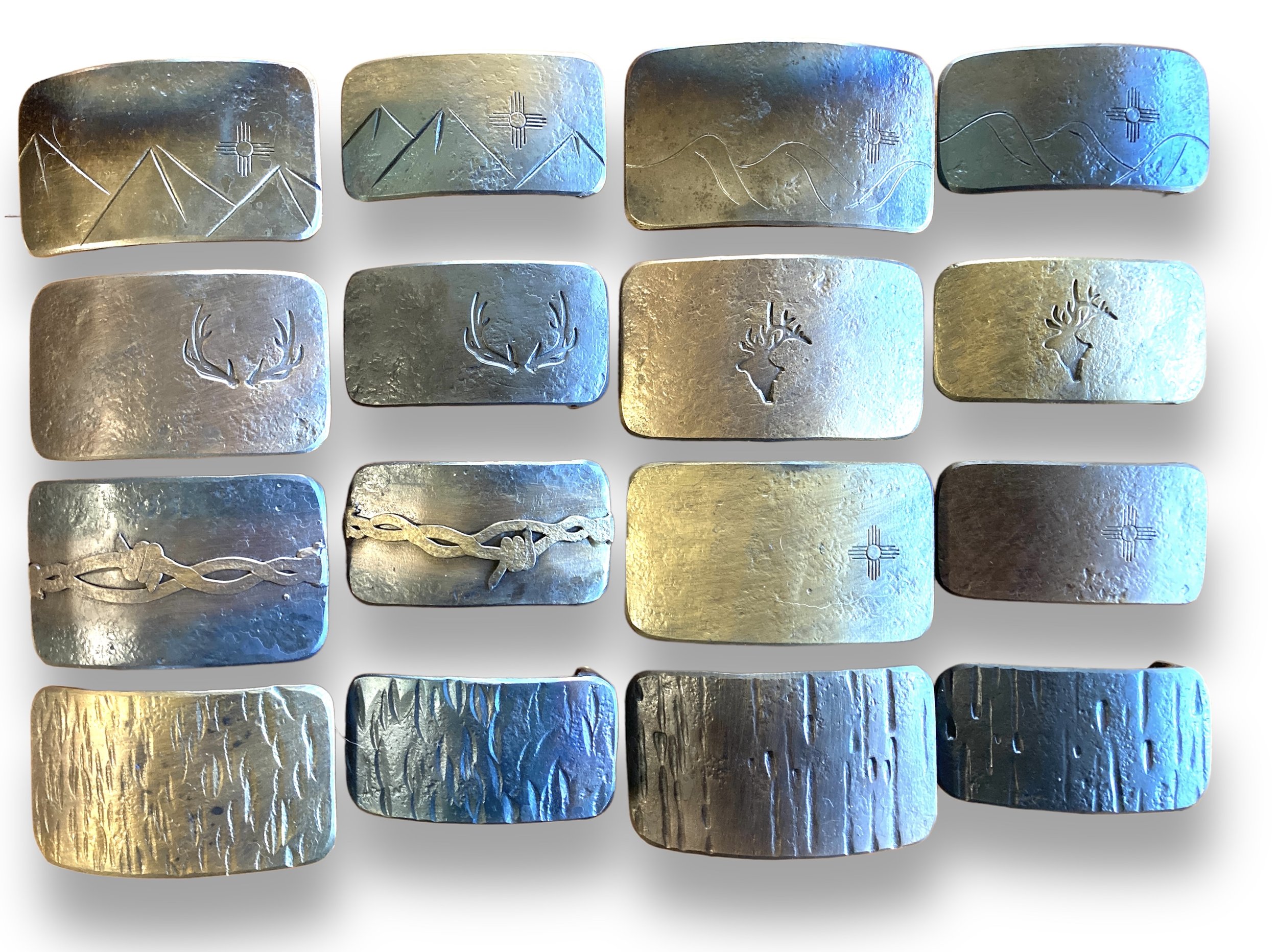
All lined up for a size comparison. A variety of Meridian hand-forged buckles shows an assortment of color possibilities.
Lastly, blacksmithing permits endless experimentation with forms. As far as a plate-style belt buckle perhaps things are more limited. However, our Barbed Wire belt buckle is still a good example. I appreciate the contrast between the flowing aspects of the barbed wire and the more rigid plate background. Similarly, the barbed wire cutouts can be manipulated such that each buckle is uniquely different from the next. Some other examples below as well.
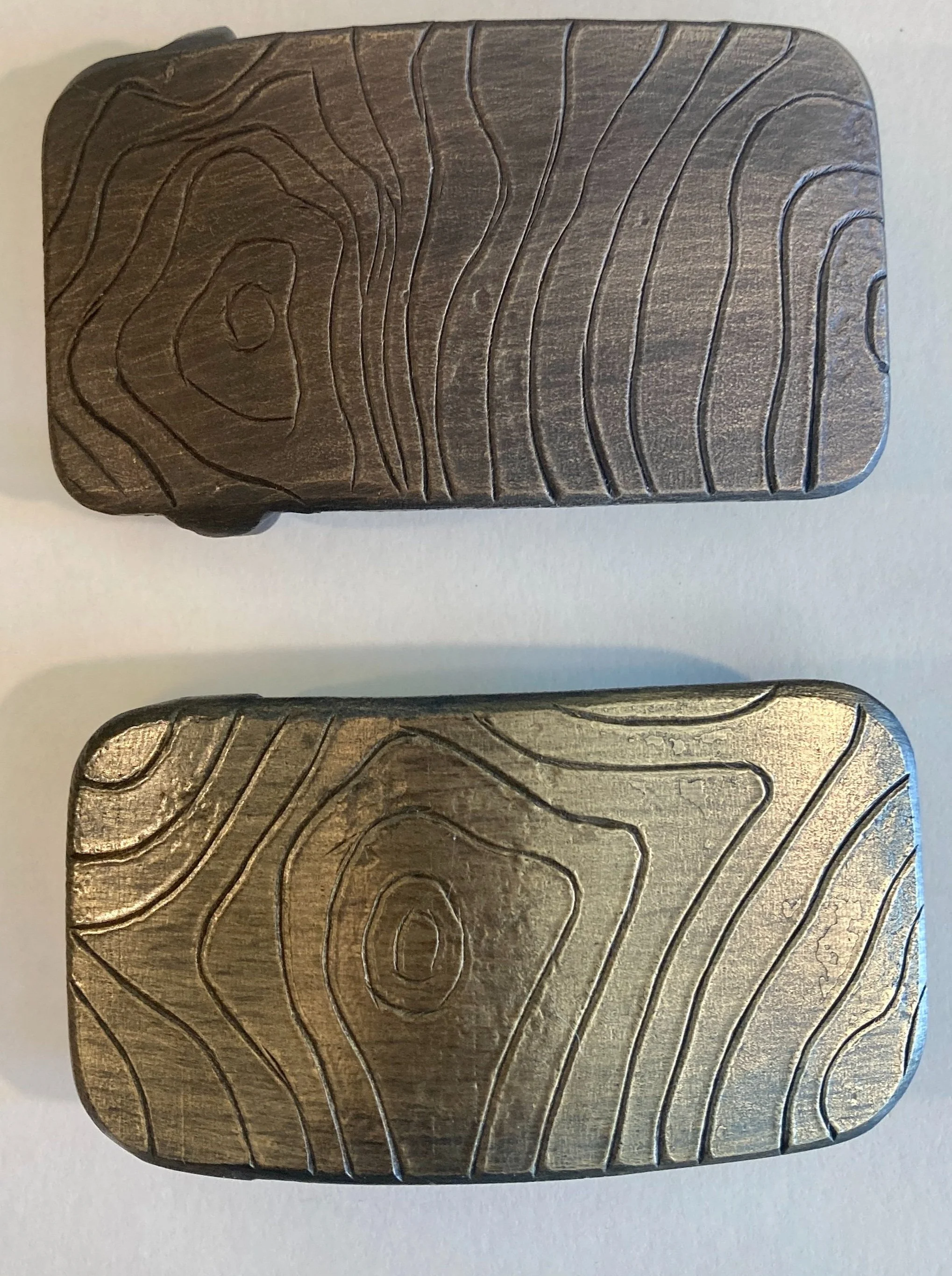
Our ‘Topo Buckles’. I made a set of custom, tiny walking chisels for myself out of some old drill bits. These have been the perfect tool for fine cold chiseling. Topographic renderings are adapted from USGS contour maps to represent favorite summits on a belt buckle. Mountains are medicine….

Our ‘Barbed Wire’ Belt Buckles; each one is unique. Spent wire from the farm finds new life on a belt buckle. And the animals appreciate less barbed wire around. I love the contrast here between the highlighted wire and the dark background.
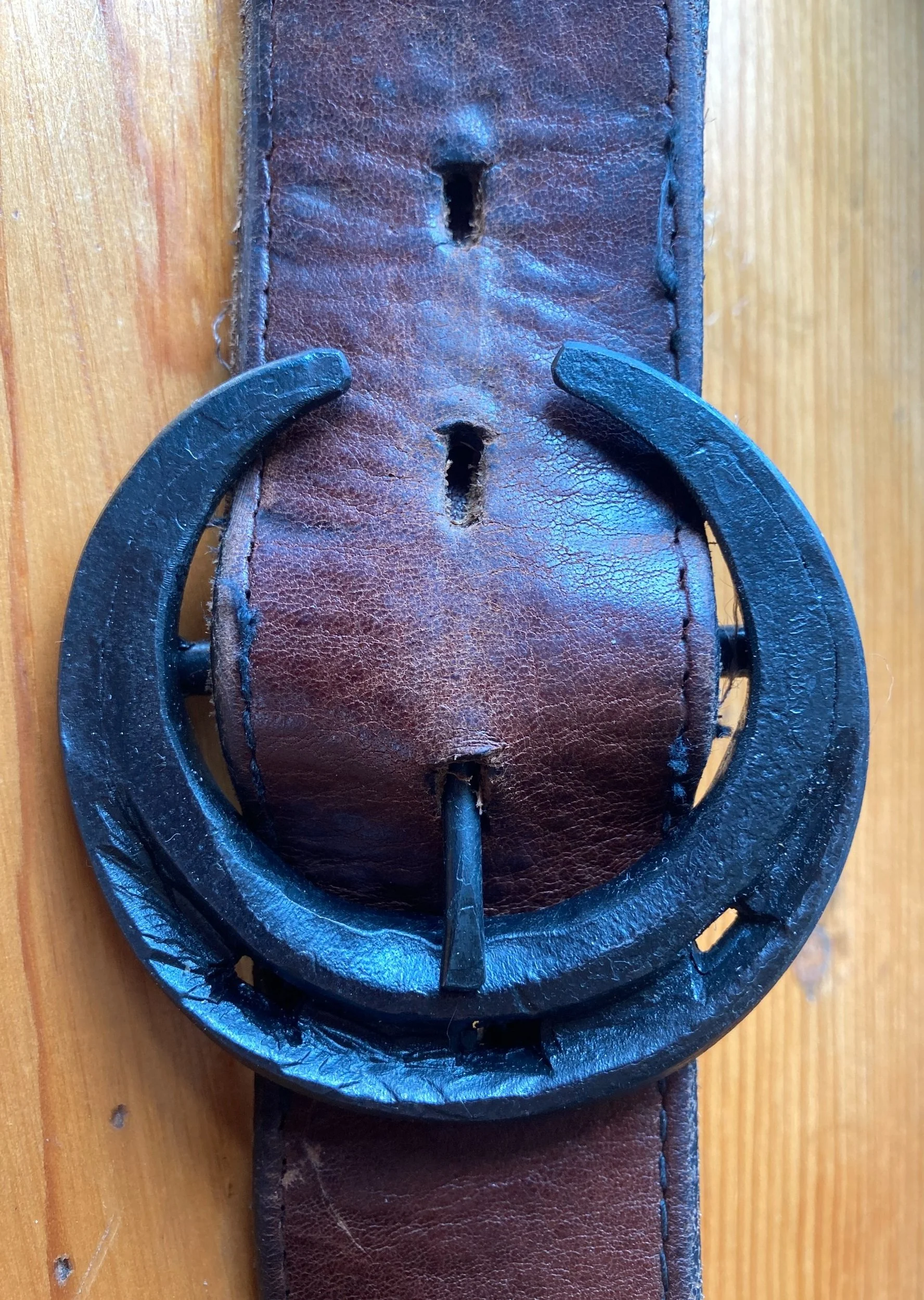
Our ‘Crescent Horseshoe Buckle’. Spent horseshoes are reborn as belt buckles. The horseshoe aspect is maintained, but also takes on a whole new form with the tapered, crescent shape. Watch a short clip of these being made!
Blacksmithing opens up worlds of possibilities for experimentation. So much so that it is at times overwhelming! Making hand-forged belt buckles has been a wonderful way to pick a discrete, forged offering and apply a variety of methods in order to both hone specific techniques as well as offer a range of unique items.
Click below to check out our variety of belt buckle offerings, or contact us to learn about custom forged works!

Strawbale Construction on a Western Montana Flower Farm
We had always been interested in strawbale construction, so decided to build a greenhouse to support our flower operation and provide a year-round grow space. While there is a ton of information out there on strawbale construction, we found that there was a bit too much technical information out there and thought that a simple photo log might be helpful. Our photos essay (read on!) will hopefully provide some inspiration and insight into our building process and help others explore natural building on their own!
We had always been interested in strawbale construction, so decided to build a greenhouse to support our flower operation and provide a year-round grow space. While there is a ton of information out there on strawbale construction, we found that there was a bit too much technical information out there and thought that a simple photo log might be helpful. Our photos essay (read on!) will hopefully provide some inspiration and insight into our building process and help others explore natural building on their own! Clicking on the first image will start the slide show. Hover each image to see a short description.
Montana Strawbale Greenhouse
Click Here for Photo Essay
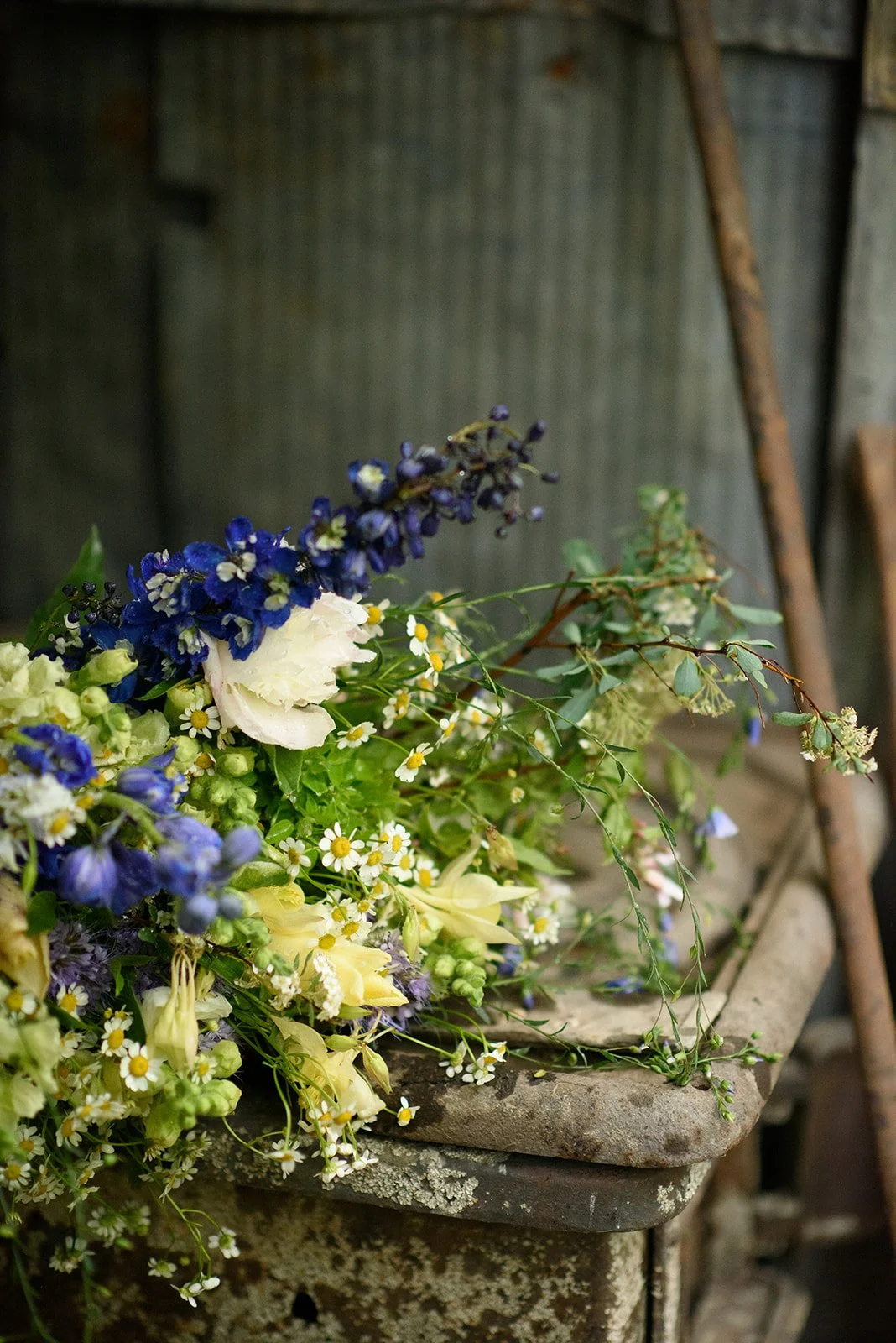
And then there were weddings . . .
Truth be told, Danielle began designing florals for weddings before there ever was a farm. She did the flowers for our wedding nearly nine years ago. too. She didn’t admit that she could do wedding floral until last year sometime. Now we’re diving in, taking pride in using only flowers we (or some of our awesome neighbors) grow.
Truth be told, Danielle began designing florals for weddings before there ever was a farm. She did the flowers for our wedding nearly nine years ago. too. She didn’t admit that she could do wedding floral until last year sometime. Now we’re diving in, taking pride in using only flowers we (or some of our awesome neighbors) grow.
To boot, once Zach really got rolling in the blacksmith shop, we realized that we also have some truly unique wedding metal to offer. Custom belt buckles for groomsmen, a singing bowl for your ceremony, hand-stamped coasters, feathers and flowers for decor . . . special items to commemorate a monumental day. It’s shaping up to be a LOVEly season. We’re kicking it off with The Barn on Mullan in Missoula, for their 2nd Annual Wedding Fair. And the raffle basket is not to be missed. Funds from the tickets for that support Jenny Horsley—a beloved member of our flower community, and a friend.


Mid Winter - Finding Purpose
I had lost purpose, that is….. until I went skiing in the Missions yesterday! Deep snow in the steep alpine, coupled with the bush-whacky adventure exit was just the break I needed from winter planning and cleaning decades of spent hay from our listing, old barn. Working a bit on the farm and forge, it has been easy to forego recreation and self-care for the sake of knocking another item or so off the ever-growing list of things to do. It seems every time I’m just about through some task, a few more rise from its ashes.

I had lost purpose, that is….. until I went skiing in the Missions yesterday! Deep snow in the steep alpine, coupled with the bush-whacky adventure exit was just the break I needed from winter planning and cleaning decades of spent hay from our listing, old barn. Working a bit on the farm and forge, it has been easy to forego recreation and self-care for the sake of knocking another item or so off the ever-growing list of things to do. It seems every time I’m just about through some task, a few more rise from its ashes.
Through all the sub-tasks, however, the larger overarching goals come into view and the vision of ‘the farm’ begins to take shape. Some might be lucky to define these things early on, but I’ve found that the culmination of the farm has been a moving target and will likely continue to be. But, the target has subtly slowed its movement in recent months due to a bit of new self-definition and clarity.
One conversation we have been having lately that has helped things slow down and granted more confidence in moving forward has centered on what ‘the things’ are that we should each be doing. These are things we are good at, that speak to us and after a full day of them, we are fulfilled. With so many balls in the air, and so many interests it’s almost as if we are trying to operate 30 different businesses between two people (hence our quest for interns). Sure, it’s Meridian Farm and Forge, but that ends up being pretty darn generalized when it comes down to nuts and bolts.
Thus, in recent months, things have focused. My luck has changed. The farm has come into clearer view. The things, as I see them, at the moment seem to be:
Farming: this vague, mis-used word which is usually associated with ‘growing stuff’, I believe is better defined as hitting shit with other, bigger shit. (Usually something made out of some hardened steel attached to a wooden handle or implement). Whether something grows or not, you are still farming, which also includes trying to grow things. But in the end, you did grow something, dug some dirt and fixed some device you originally thought was unfixable….you have found satisfaction.
Blacksmithing: perhaps more forgiving than carpentry and less so than making decent coffee, this craft is quite rewarding and relatively magical. In the most basic sense - you take something completely unbending, heat it up to incredible temperatures and then turn into something beautiful (or often times ugly), and/or quite useful. My fear is that this and other associated skills are lost in our new humanity as we rely too much on the wills and technologies of others and don’t grab the horns of our own ingenuity.
Everyone can do everything.
Baking: bread is delicious and very nourishing. Fresh bread even more so. With melted butter…. even more so. Enough said.
…. let’s try and ski a bit more too, eh?
Sounds like a good mix, right?
The funny thing is, ten years ago this was not my path and these were not things that I did. Ten years ago, I would normally be caught writing computer programs for some sort of environmental data analysis and would have defined myself via a hierarchical corporate job-class structure. But now, these are the things that wholly define my time, shape my body and challenge my mind; until death do us part.
The takeaway: anyone, everyone is not stuck and can reinvent themselves in any way that they need or want. We are put and put ourselves into categories, bins, etcetera based off where we came from and associated past experiences. If we want, we can switch it up and see each other for who we want to be and where we are going.

At Summer's End
As we near the close of our first “official” season on the farm, I find myself exhausted and awash . . . in gratitude. We couldn’t have asked for a better summer. Sure, it was slow to start, but in some ways, that allowed us to catch up. We put in our first growing field this spring. That meant fencing, prepping soil and rows, placing irrigation and planting somewhere around 2000 plants. We only suspected what the season would be like and therefore we were cautious in setting goals and realistic about the fact that we really had one person working the farm because the other was usually parenting. Still, we got our butts whooped and hearts full up.
Our first CSAA was a smashing success.

As we near the close of our first “official” season on the farm, I find myself exhausted and awash . . . in gratitude. We couldn’t have asked for a better summer. Sure, it was slow to start, but in some ways, that allowed us to catch up. We put in our first growing field this spring. That meant fencing, prepping soil and rows, placing irrigation and planting somewhere around 2000 plants. We only suspected what the season would be like and therefore we were cautious in setting goals and realistic about the fact that we really had one person working the farm because the other was usually parenting. Still, we got our butts whooped and hearts full up.
Our first CSAA was a smashing success. We sold every share and our people were pleased as pie. I loved watching the bouquets become more abundant, seeing what Zach forged and creating some sweet felted art with my own hands. Of course feeding folks always gives me pleasure, so adding food to their basket each week fulfilled my mama bear urges. And that continues, as our hens’ eggs make their way to the Dixon Mercantile each week and we bring our wares to the Mission Falls Market.
Sometimes the work had our heads down long enough that we forgot to look at the birds flying over and we certainly found ourselves surprised by the abundance that flourished all around us. But that is part of the joy, that ebb and flow, that fruition for one’s toil, that blossoming of the dreams, putting beauty right there in the palm of your dirty hand.
As the rains get cooler and the days shorter, we find ourselves ready—ready to wind down and hunker in. Ready to plot and plan and craft through the snows. Next summer, we’ll have more hands to help us, and hopefully a few wholesale customers for our flowers, and you bet we’ll be offering another CSAA of some sort, along with a simple flower CSA—for longer and for more. Bee classes are in the works. Buzz Buzzz.
Thank you to all who are showing us support on this journey. We hope to bring it back to you in spades.
Ruminating on Spring
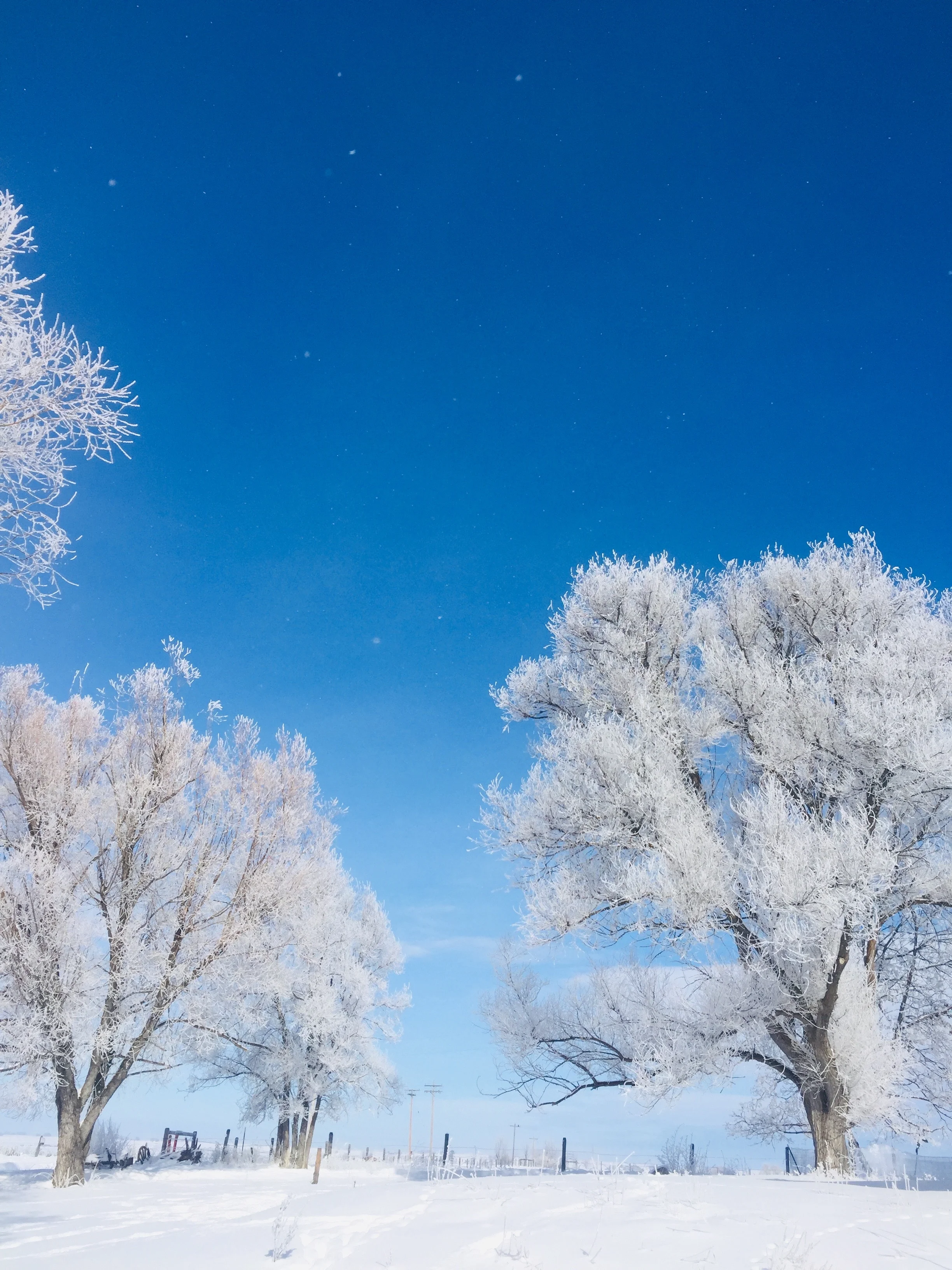
It’s been an odd winter: hardly winter at all until February, then winter as it should be. A good deal of glorious snowfall and negative temps to check the population of true bugs that have taken over our wood pile. And then many foggy mornings adorned in feather frost or faerie frost, depending on who is doing the telling. What difference does it make though? It all has to do with wings.
It’s been an odd winter: hardly winter at all until February, then winter as it should be. A good deal of glorious snowfall and negative temps to check the population of true bugs that have taken over our wood pile. And then many foggy mornings adorned in feather frost or faerie frost, depending on who is doing the telling. What difference does it make though? It all has to do with wings.
Speaking of wings, we had 26 baby chicks arrive last Thursday and their fuzz is already giving way to feathered wing tips. Our delight and joy in the arrival was quickly hampered—a rough journey took seven of them away in the first two days. Living on a farm, people will often say “That’s life on the farm.” And while it isn’t wrong—except maybe it should be “that’s death on the farm”— losing animals is never easy, never taken lightly in our hearts, and I always try to find a way to do better, in honor of those we lose. Even though I recognize that there is much we have no control over. Happily, thankfully, the others are thriving and living in an old trough in our pantry—until warmer temps. It was -18 at daybreak today! I think the sheep are the only folks who don’t mind.
Yesterday, Zach and I tromped around in the snowy pasture—up to our knees, stamping out our vision for the growing fields we will create this year. We (Zach, Gideon and I) arrived to this land just shy of one year ago and inherited 4 sheep, 3 cats, 30 chickens and a few gardens. Of course, we brought Bandito and the bees with us. Needless to say, we’ve needed some time to settle in, adjust to the rhythms of this lovely home and get to know the animals.
But now, it’s game on! We are eager for spring and dreaming of making more progress toward realization of our vision for this sweet spot—a vision that includes a place of learning and retreat for family, friends, neighbors, our wild and domestic animal neighbors, and friends we have yet to meet.
I can’t make any promises about how often we will post an entry, but this is the place to check in on what’s happening with the farm and forge. There are so many things we are excited about, but being able to offer our first CSAA is definitely near the top of the list (our lists are more like bubbles rising).
Thanks to all who’ve supported us as we journey along this dream. It’s for all of us.
Love and Gratitude,
Danielle

“One tree is another tree, but not too much. One tulip is like the next tulip, but not altogether. More or less like people—a general outline, then the stunning individual strokes. Hello Tom, hello Andy. Hello Archibald Violet, and Clarissa Bluebell. Hello Lilian Willow, and Noah, the oak tree I have hugged and kissed every first day of spring for the last thirty years. And in reply, its thousands of leaves tremble! What a life is ours! Doesn’t anybody in the world anymore want to get up in the
middle of the night and
sing?”
Mary Oliver, Upstream