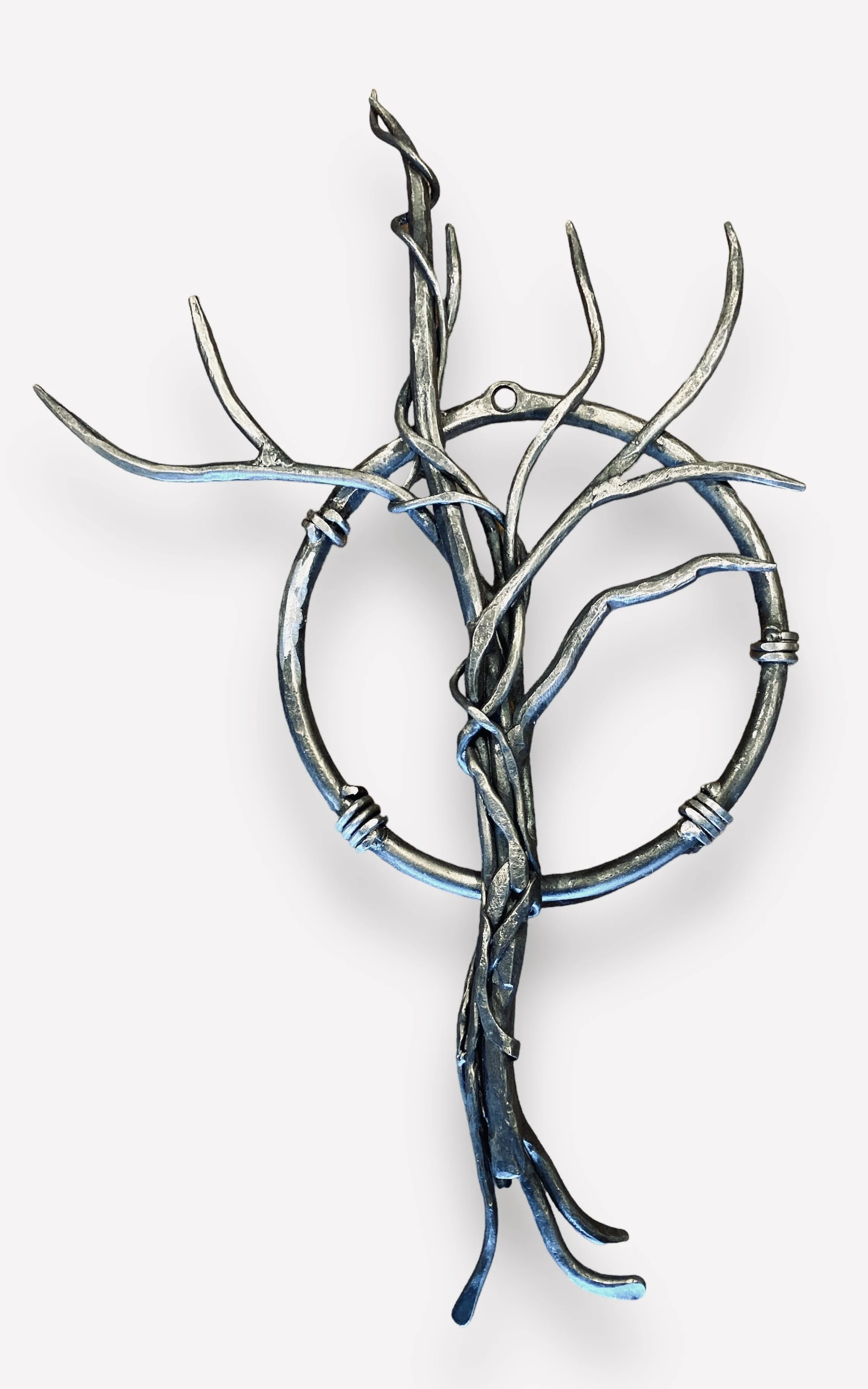
Finding the Art in Artisanal Blacksmithing
As I mentioned in a previous post relating to my belt buckle work, forging metal opens up so many possibilities in terms of form and texture. While I have dabbled a bit in the more artisanal aspects of blacksmithing, I am excited to be diving more seriously into formal artwork.
As I mentioned in a previous post relating to my belt buckle work, forging metal opens up so many possibilities in terms of form and texture. While I have dabbled a bit in the more artisanal aspects of blacksmithing, I am excited to be diving more seriously into formal artwork.
A recent trip to Santa Fe, NM and discussions with other, more established artists lit the fire under me and I made some important realizations:
I fee like I’m finally able to leverage a broader skillset obtained through the last 10 years of blacksmithing,
I’m somehow more open and inspired and seem to be experiencing a near constant flood of ideas to work on (!?)
A newfound understanding of how to approach galleries, museums and other art outlets doesn’t hurt (essentially, I have plan and the prospect doesn’t feel as daunting as it did)!
In recent years, I have been lucky to have consigned some of my pieces with remarkable businesses such as 4Ravens Gallery in Missoula, Ninepipes Museum in Charlo and the Paws Up People and Culture Center in Missoula. However, more recently, a piece “Ammonite Study” was accepted into Helena’s Holter Museum 2024 Art Auction. I’m very excited about this!

Ammonite Study

Detail
Lastly, I have been developing a separate artwork page (work in progress) that can be found HERE, and plan to continue to support Montana arts by submitting pieces to fundraiser events throughout Montana over the next year. Simultaneously, I will be slowly building a body of work; some themes I look forward to exploring separately and/or jointly include:
Geology, Earth Process and Landscape
Bowls and Vessels
Hand Tool Appreciation
Fossil forms
Early Industrial Forms
Wildlife and Origami
Jewish Heritage
Thanks for visiting and stay tuned!

There’s Treasure Everywhere
Recently, while wondering in the Missions, I found a cup! It was of the insulated, stainless steel type; perfect for hot drinks on cold days in the blacksmith shop. Having just been perusing Calvin and Hobbes, I thought to myself… “there’s treasure everywhere!”
Recently, while wondering in the Missions, I found a cup! It was of the insulated, stainless steel type; perfect for hot drinks on cold days in the blacksmith shop. Having just been perusing Calvin and Hobbes, I thought to myself… “there’s treasure everywhere!”

Hello new cup!
This perspective can be brought into just about any aspect of life of course, but it got me thinking that especially in my blacksmith work - there really is treasure everywhere in the form of scrap metal that can be repurposed for a variety of specific tools or tasks.
Steel is wrought as a large variety of alloys, its content optimized for some specific use or small range of uses. When a specific tool or part, be it a car spring, drill bit or tiller blade, reaches the end of its life span, it can easily be reborn as something else via the forge. Here are some examples:

While wondering some train tracks a few years ago, I found this ~ 1.5” round bar stock (foreground). That it sheared so raggedly (on the left hand side), indicated it was some higher carbon steel. Cutting off a chunk, punching a hole and offsetting the face produced a handy ‘set hammer’ (handled tool, top). A nice tool for establishing tenons over the edge of the anvil.
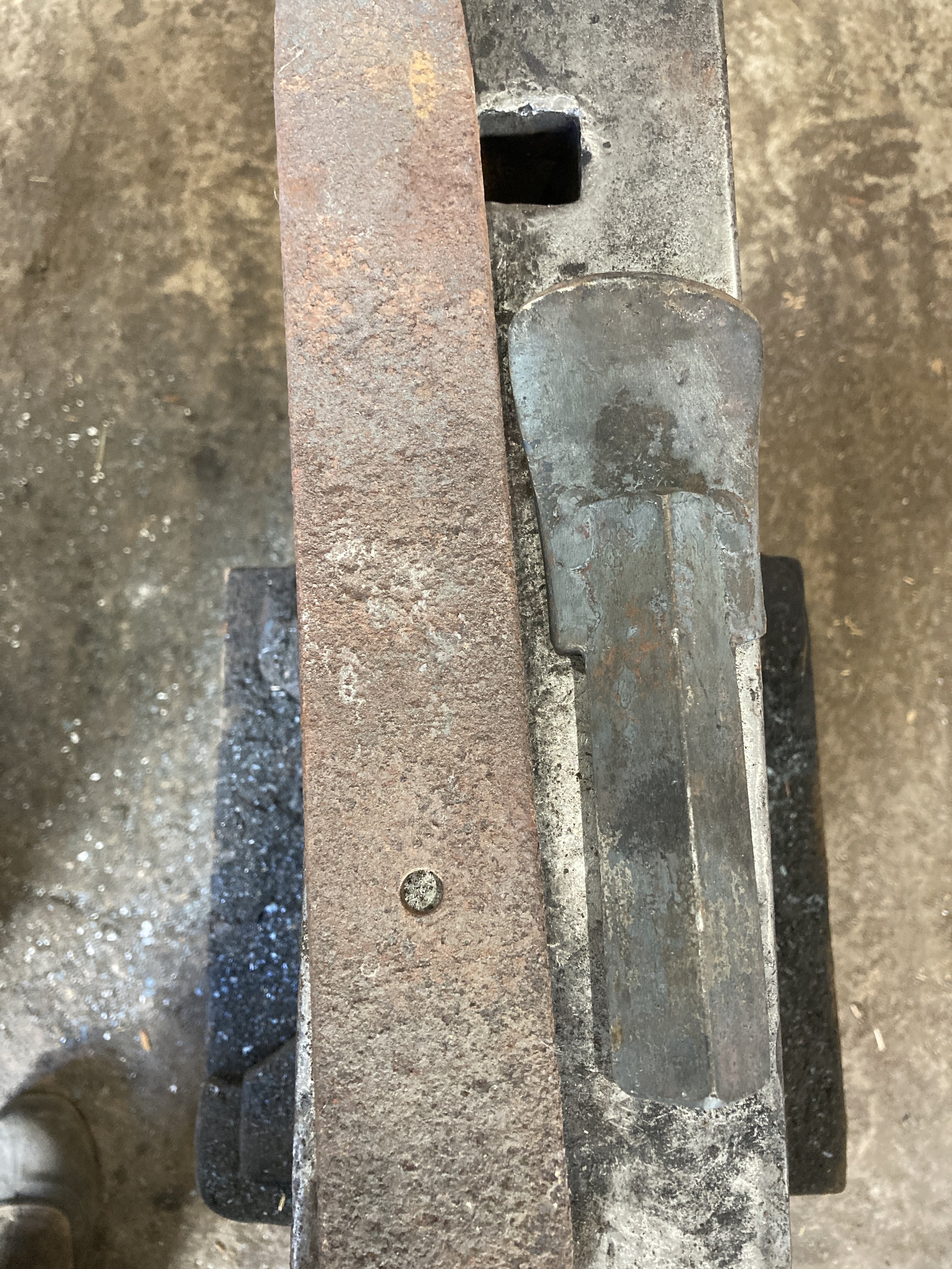
On the left is a leaf spring a buddy found (also in the Missions, a range of infinite resource!). There are many applications for leaf springs as they are a great source of high carbon steel in handy stock dimensions. Here, a small piece was forged and welded to some angle iron to fit the hardy hole (square hole on the anvil) to be used as a hot cutter.
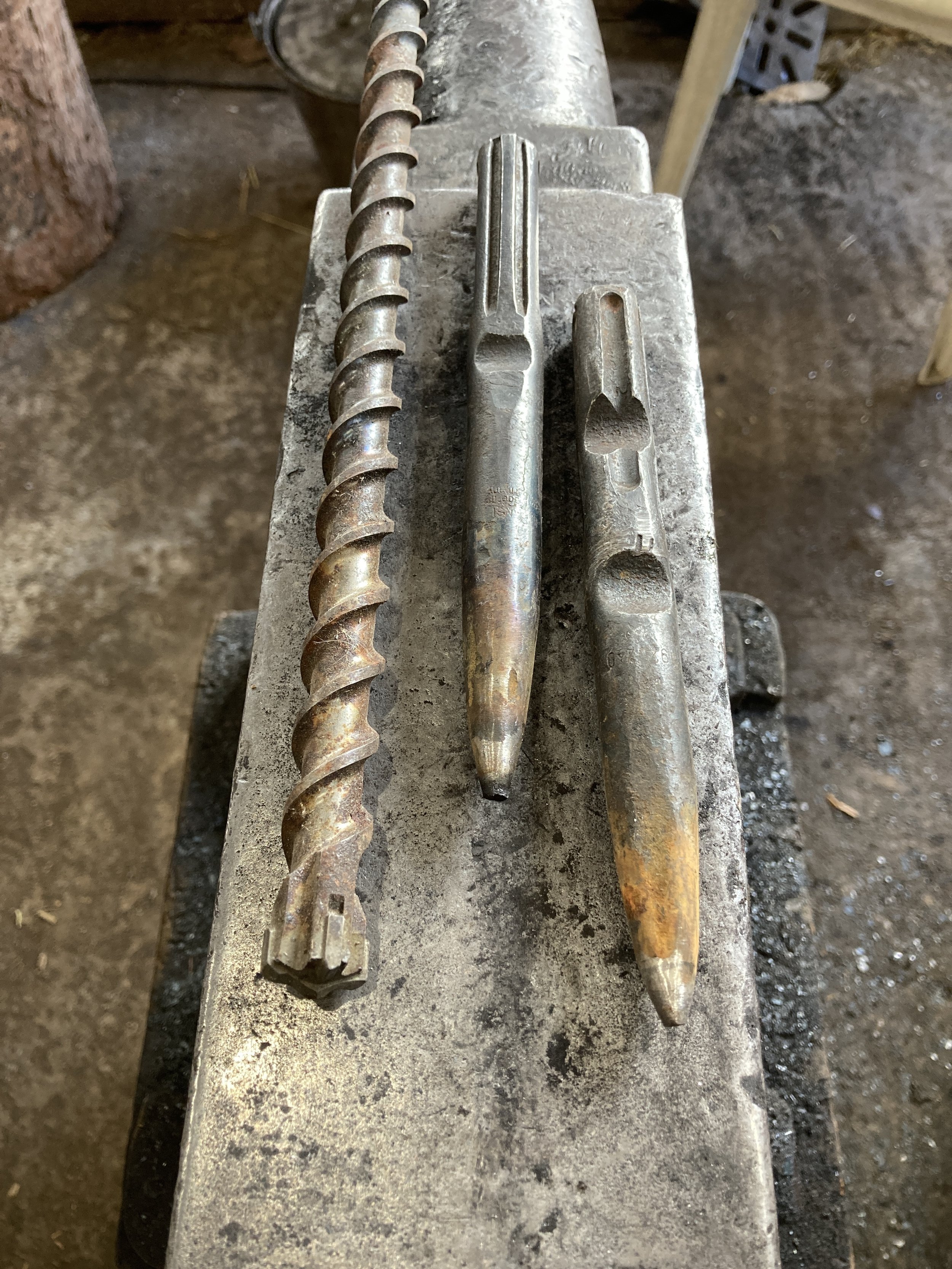
Abandoned hammer bits like this one (on the left) make great stock for general blacksmithing tools such as punches and chisels. Both hot punches were forged from the upper shaft of this drill bit. I use these every day! Thanks old drill bit!

A few years ago, when my neighbor was delivering a round bale of hay, he accidentally broke the hay spike off into the bale, leaving behind a nice bar of high carbon steel.

Here, the tip of the spike has been cut off and welded to some forged stock I found in my scrap pile (an abandoned project of some sort I can’t recall). The tool (right) will serve to spread out holes in heavy stock for taper candles.

I rarely throw steel away (well it gets recycled at the scrap mill if I really can’t use it). I typically try to hold onto all scraps and drops.

Desperate for some scrolling tongs at one point, I forged this pair strictly from bits found in the scrap buckets.
While it may be obvious, it’s important to note that steel is a durable good, and nearly, infinitely reusable. In any case, these are just a few examples amongst many of recycling potential in metalwork.
Lastly, while blacksmithing is inherently gratifying work, the practice of reusing old materials through resourcefulness, adaptability and creativity is one of my favorite aspects of it.

Belt Buckle : Tool for Innovation and It Holds Up Your Pants!
Tool making is an integral part of blacksmithing. There are so many tools to make in the blacksmith shop: tongs, hammers, punches, chisels, drifts, hardy tools, jigs, fullers, swages, etc. On the farm, there are rakes, pitchforks, shovels, scythes and sickles. In the kitchen, there are knives, spoons, bottle openers and on and on. There is an endless fleet of steel tools to be forged!
When I began working with metal, I didn’t think I’d be making belt buckles. But isn’t a belt buckle just another tool?
Tool making is an integral part of blacksmithing. There are so many tools to make in the blacksmith shop: tongs, hammers, punches, chisels, drifts, hardy tools, jigs, fullers, swages, etc. On the farm, there are rakes, pitchforks, shovels, scythes and sickles. In the kitchen, there are knives, spoons, bottle openers and on and on. There is an endless fleet of steel tools to be forged!
When I began working with metal, I didn’t think I’d be making belt buckles. But isn’t a belt buckle just another tool?
Other than holding up one’s pants, I’ve found that making belt buckles is a great way to experiment with the various textures, colors and forms available when working with metal.
There are myriad textures to be achieved in metals via blacksmthing. From punching out shapes with square or circular punches, varying one’s hammer strikes or types of hammers, or even applying weld marks will yield interesting results.
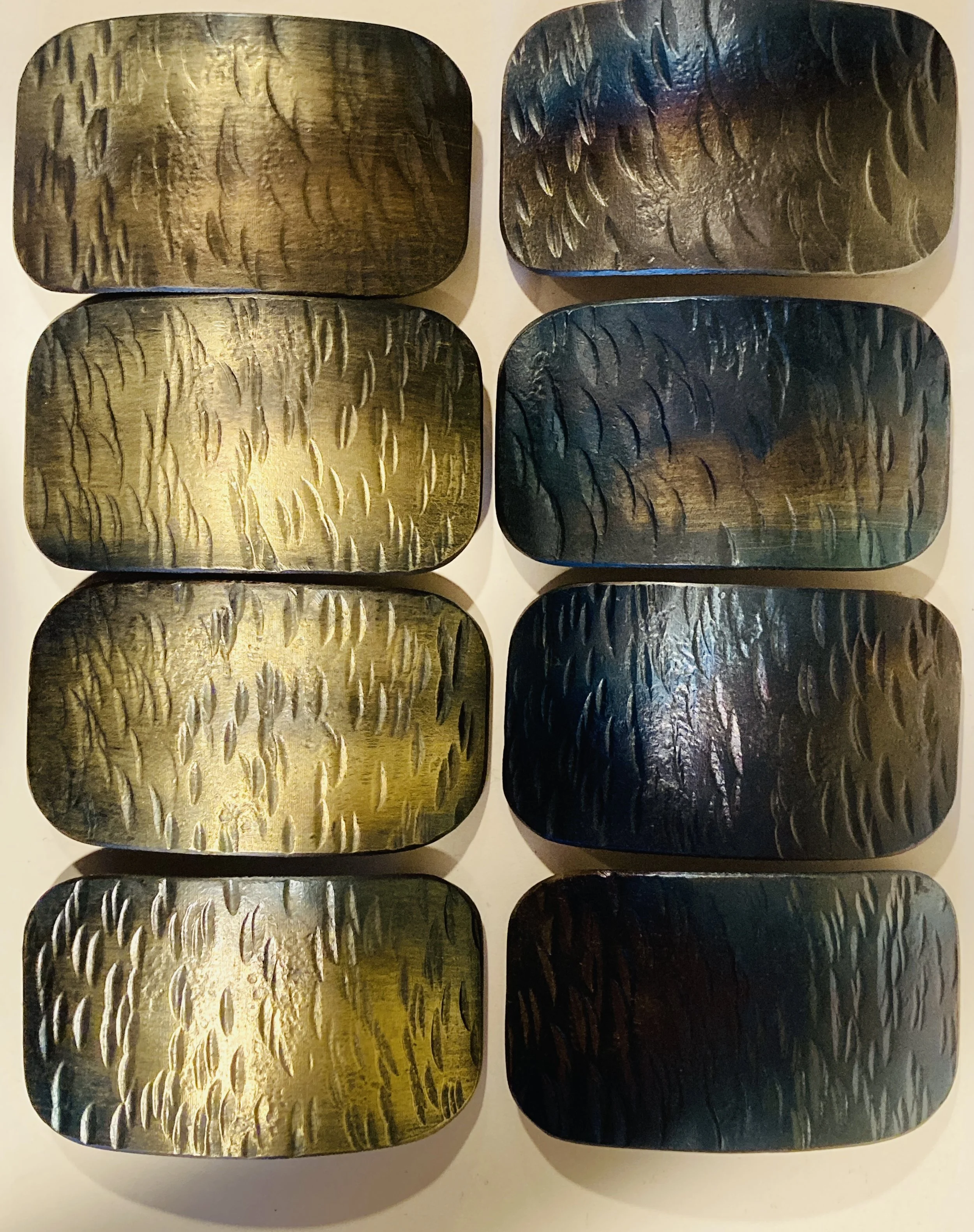
‘Waves’ hand-forged belt buckle. Texture achieved through use of a hand-sledge with a sharp round edge swung repeatedly at an angle.
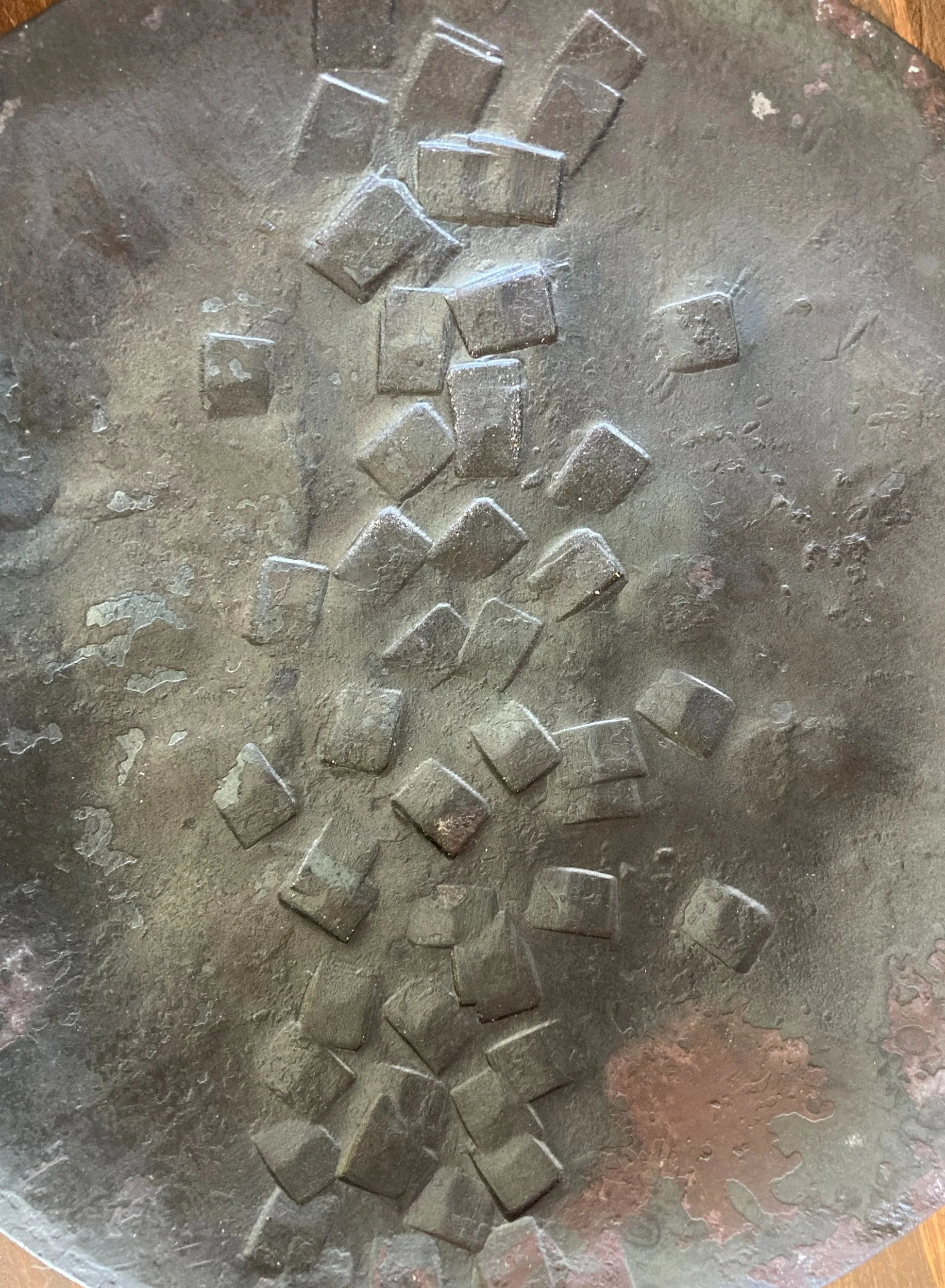
Square punch marks tested on a a small hand-forged dish. I made a standard, handled square punch which was used to assess a pattern of square marks. Looking forward to applying this technique to belt buckles (and light-switch plates) later this winter.
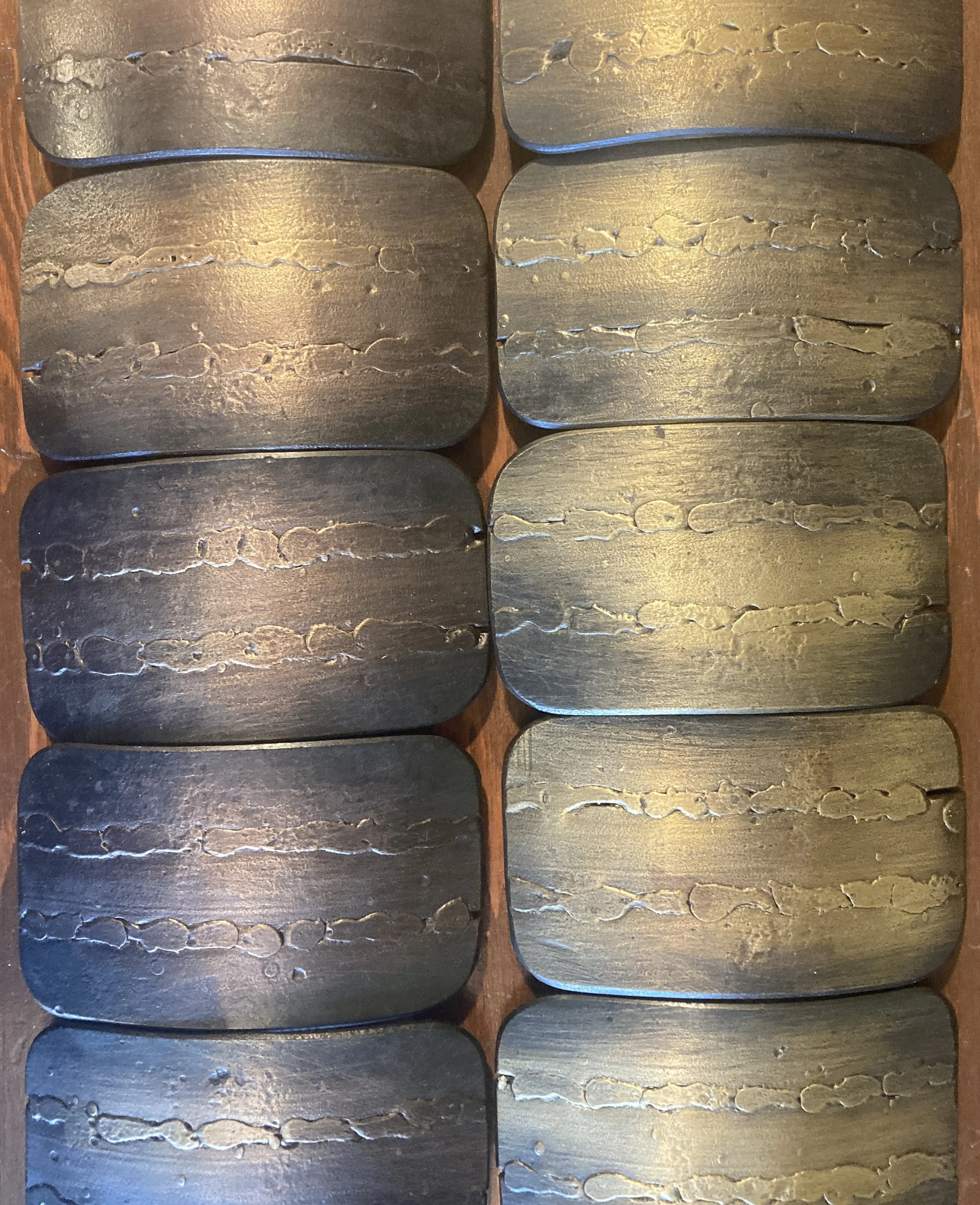
‘Welded Panels’ hand forged belt buckle. This is one of my favorites. Here, strips of steel are fused via sloppy weld beads. I then forge them flat to get this unique texture.
In my limited pursuits, I’ve managed a lot of color variation. Applying a heat gradient through polished steel (and other metals) yields oxidation color gradients - which in steel can be very striking and interesting. Depending on temperature, these gradients can be captured in the final piece in unlimited ways. In addition, various tones can be wrought through brass plating at different temperatures. Mixing these techniques results in a lot of different coloring combinations.
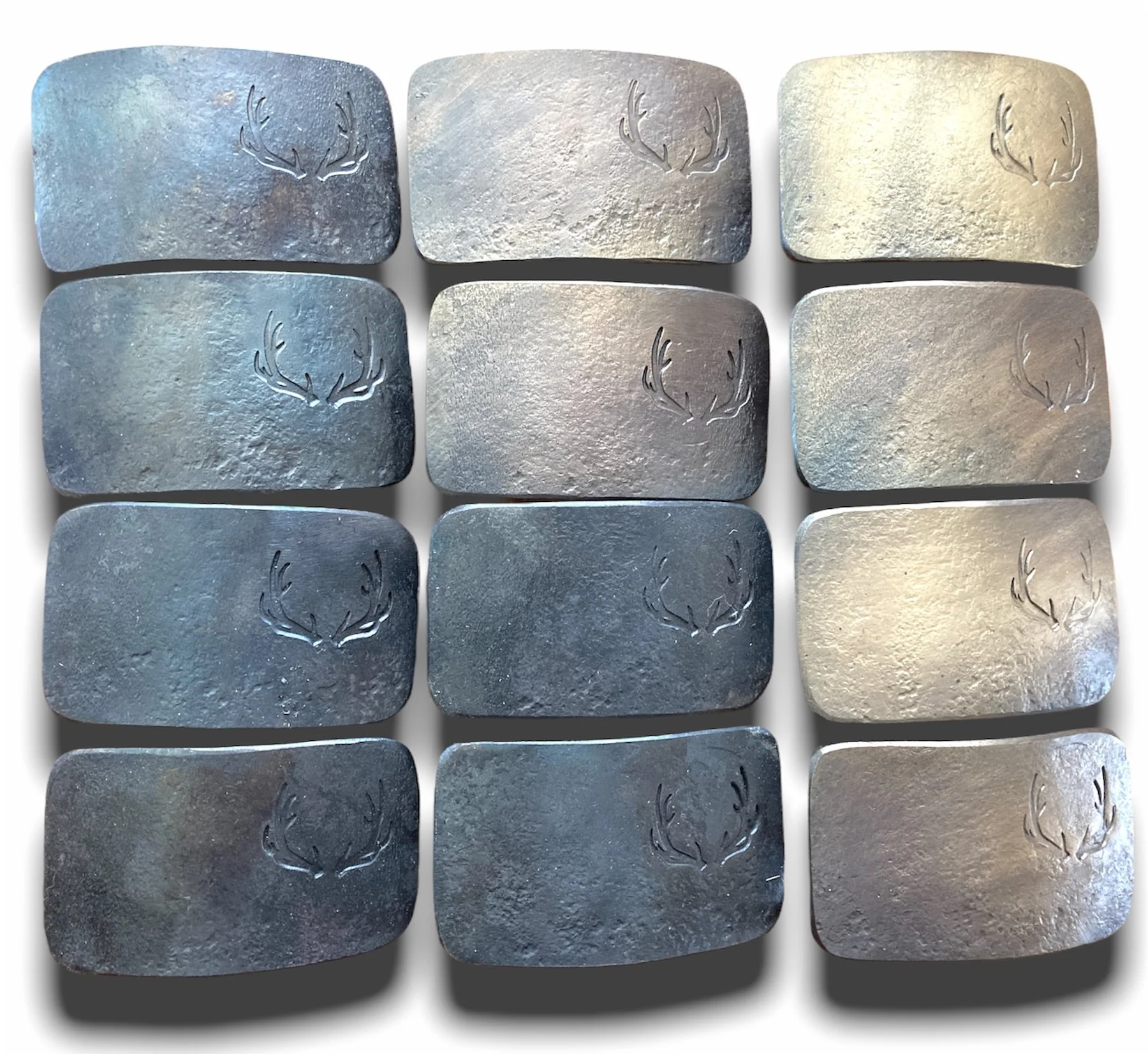
“Elkhorn” hand-forged belt buckle. The color gradient shown here is achieved by uniform heating of the buckle to a specific temperature before ‘arresting’ it with a quench.
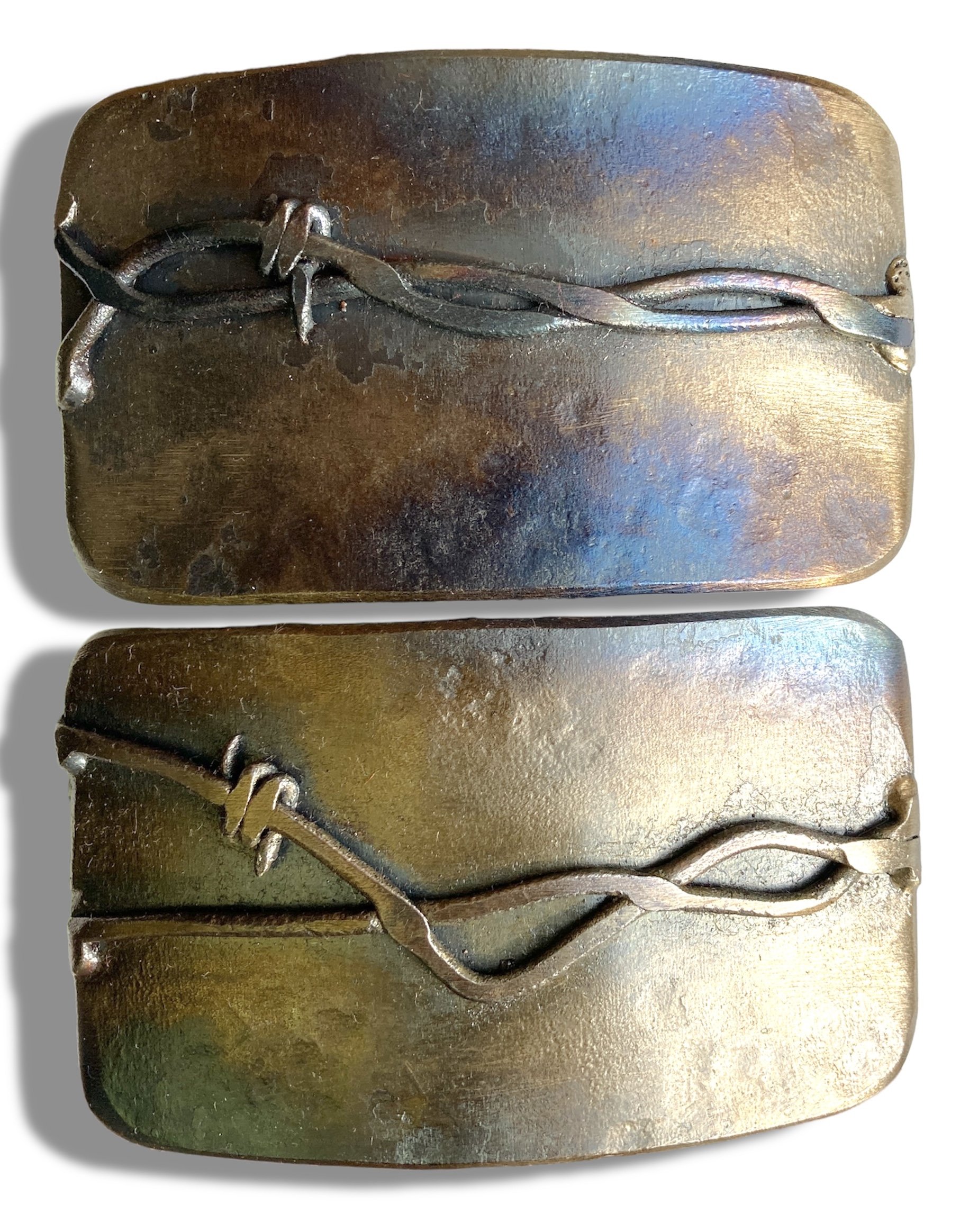
‘Barbed Wire’ belt buckle. Super fun to make. The coloring here is made by ‘running the colors’ across the buckle via asymmetric heating.
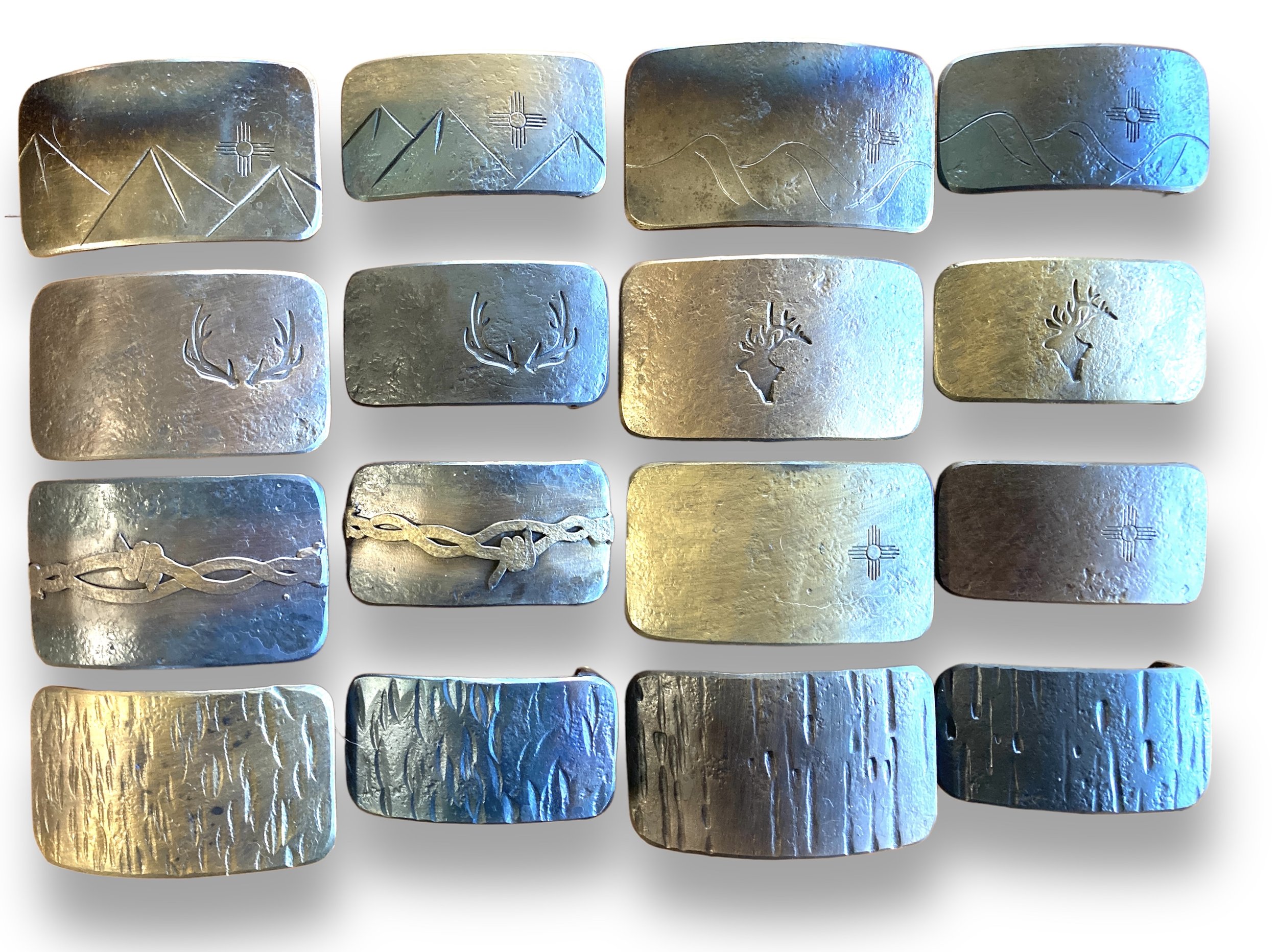
All lined up for a size comparison. A variety of Meridian hand-forged buckles shows an assortment of color possibilities.
Lastly, blacksmithing permits endless experimentation with forms. As far as a plate-style belt buckle perhaps things are more limited. However, our Barbed Wire belt buckle is still a good example. I appreciate the contrast between the flowing aspects of the barbed wire and the more rigid plate background. Similarly, the barbed wire cutouts can be manipulated such that each buckle is uniquely different from the next. Some other examples below as well.
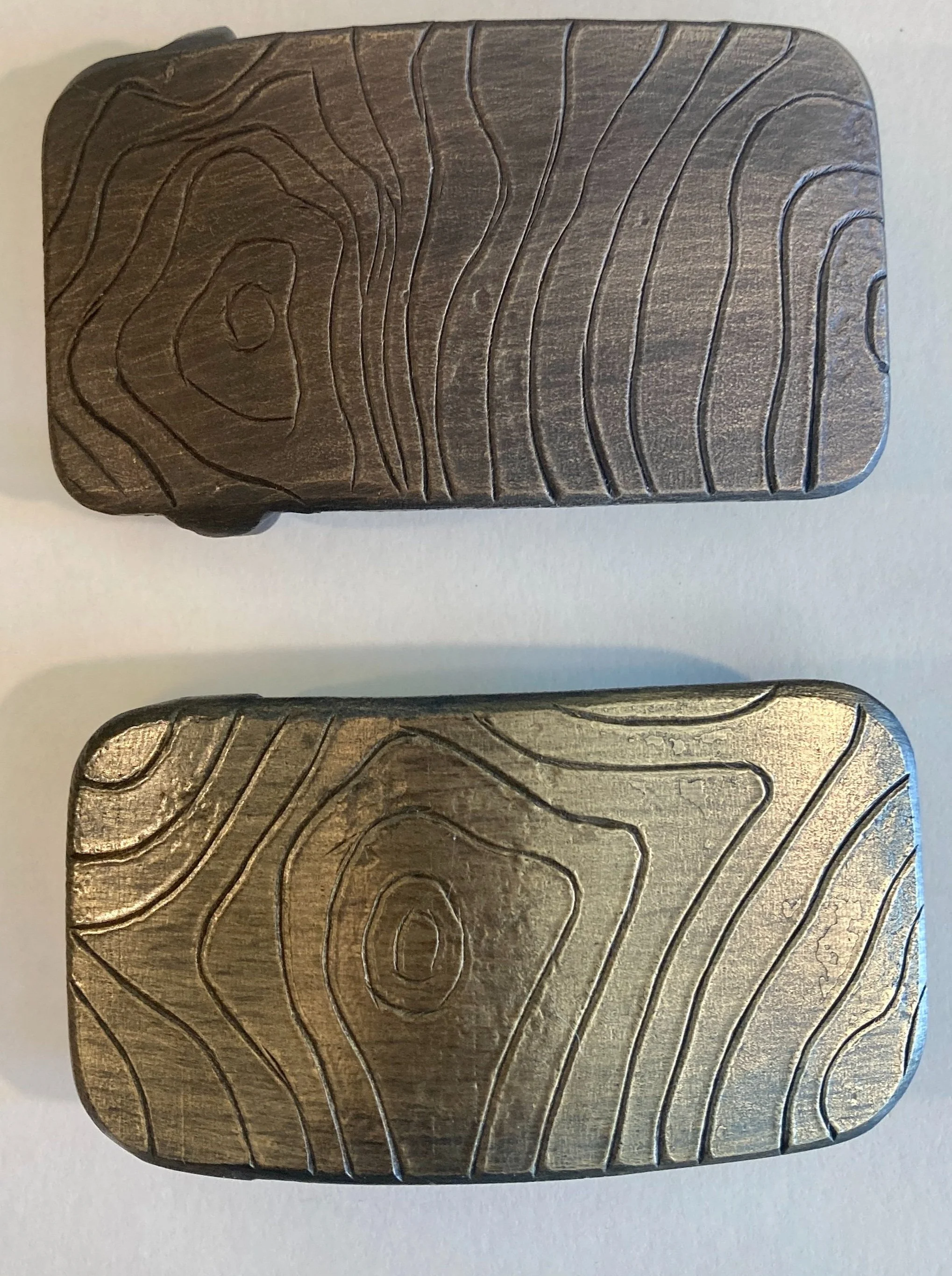
Our ‘Topo Buckles’. I made a set of custom, tiny walking chisels for myself out of some old drill bits. These have been the perfect tool for fine cold chiseling. Topographic renderings are adapted from USGS contour maps to represent favorite summits on a belt buckle. Mountains are medicine….

Our ‘Barbed Wire’ Belt Buckles; each one is unique. Spent wire from the farm finds new life on a belt buckle. And the animals appreciate less barbed wire around. I love the contrast here between the highlighted wire and the dark background.
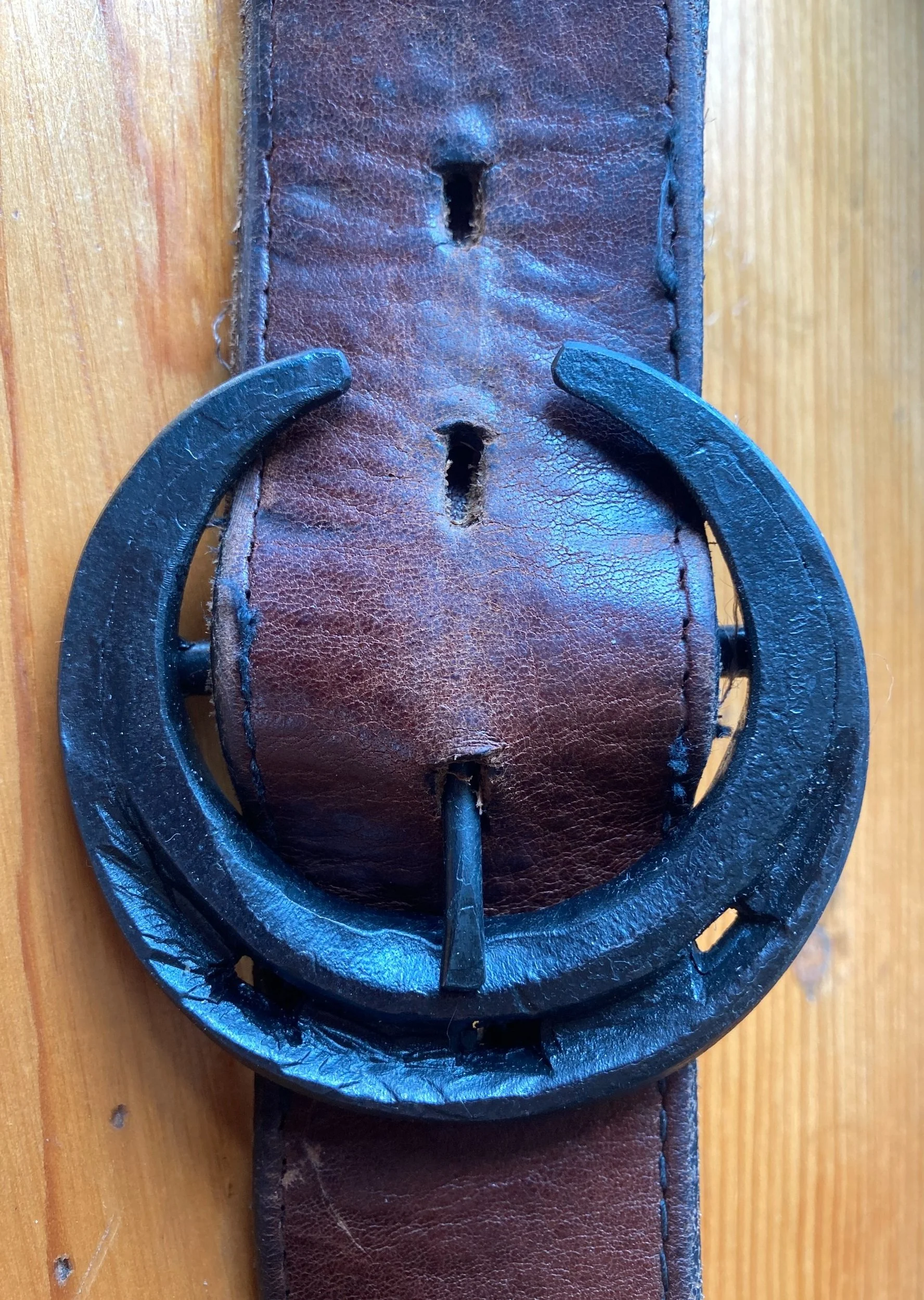
Our ‘Crescent Horseshoe Buckle’. Spent horseshoes are reborn as belt buckles. The horseshoe aspect is maintained, but also takes on a whole new form with the tapered, crescent shape. Watch a short clip of these being made!
Blacksmithing opens up worlds of possibilities for experimentation. So much so that it is at times overwhelming! Making hand-forged belt buckles has been a wonderful way to pick a discrete, forged offering and apply a variety of methods in order to both hone specific techniques as well as offer a range of unique items.
Click below to check out our variety of belt buckle offerings, or contact us to learn about custom forged works!